
Table of Contents
ToggleIntroduction
In today’s competitive manufacturing landscape, businesses are expected to deliver better quality, faster production, and consistent results while controlling operational costs. Achieving all of these goals begins with investing in the right equipment. Companies looking for reliable Tapping Machine Suppliers often realize that selecting quality machinery is one of the most important decisions they can make for improving productivity and maintaining consistent manufacturing standards.
Manufacturing efficiency is not simply about producing more products within a shorter period. It is about producing every component with accuracy, minimizing waste, reducing machine downtime, improving workplace safety, and ensuring every process runs smoothly from start to finish. Even highly skilled operators struggle to maintain quality when working with outdated or poorly maintained equipment.
Across industries such as automotive, aerospace, electrical manufacturing, heavy engineering, medical equipment, and fabrication, businesses are modernizing their production facilities to remain competitive. One of the biggest reasons behind this transformation is the realization that better equipment delivers measurable improvements across every stage of manufacturing.
This article explores why equipment plays such an important role in manufacturing efficiency, how modern technology improves operations, and what businesses should consider before investing in new machinery.
Why Equipment Is the Foundation of Manufacturing Efficiency
Every manufacturing process depends on consistency. Whether producing one hundred parts or one hundred thousand, every component should meet the same quality standards.
Equipment directly affects
- Product quality
- Production speed
- Material utilization
- Worker safety
- Energy consumption
- Maintenance costs
- Customer satisfaction
When machinery performs consistently, production becomes predictable. This allows manufacturers to meet delivery schedules, reduce rejects, and improve profitability.
Modern equipment is designed to minimize human error while maintaining repeatable accuracy throughout continuous production cycles. Even small improvements in precision can significantly reduce waste over thousands of manufactured components.
Businesses that invest in better machines often experience improvements not only in production capacity but also in customer confidence because consistent quality strengthens long term business relationships.
The Hidden Costs of Outdated Machinery
Many manufacturers postpone equipment upgrades because existing machines continue operating. While this appears cost effective in the short term, aging machinery often creates expenses that remain unnoticed until they begin affecting productivity.
Some of the most common hidden costs include
-
Frequent Breakdowns
Older machines typically require more maintenance.
Unexpected failures interrupt production schedules, delay deliveries, and increase repair expenses.
Each hour of downtime can affect multiple departments, creating delays throughout the manufacturing process. -
Poor Accuracy
Wear and tear gradually reduce machining precision.
Small dimensional variations may seem insignificant initially but eventually increase rejection rates and customer complaints.
Maintaining consistent thread quality becomes increasingly difficult as machine components wear over time. -
Higher Energy Consumption
Modern manufacturing equipment is engineered to operate more efficiently.
Older systems often consume significantly more electricity while producing lower output.
Reducing unnecessary energy usage helps manufacturers lower operating costs without compromising productivity. -
Increased Material Waste
Inaccurate machining produces defective parts that cannot be reused.
Material waste directly impacts profitability, especially when expensive metals or specialty materials are involved.
Improved accuracy helps manufacturers maximize raw material utilization.
Precision Creates Better Products
Quality manufacturing depends on precision.
Customers expect components to meet exact specifications regardless of production volume.
Even slight deviations can affect product performance, assembly, or safety.
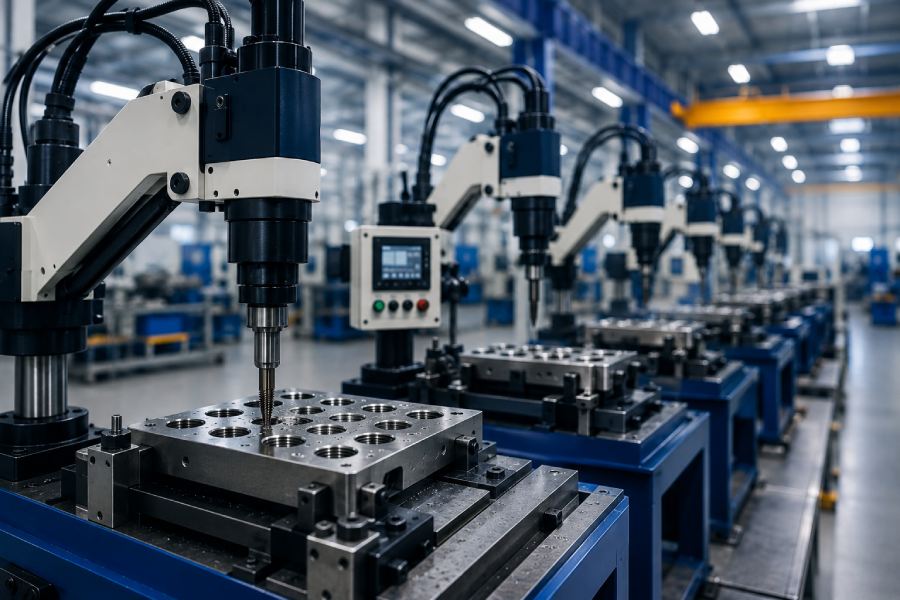
A modern tapping machine plays a crucial role in achieving accurate internal threads that match required engineering standards. Consistent threading improves assembly quality, extends product life, and reduces rework.
Precision offers several important advantages.
-
Better Product Consistency
Uniform dimensions improve compatibility between components.
This reduces assembly issues and simplifies quality inspections. -
Reduced Rework
Accurate machining minimizes the need for additional finishing operations.
Manufacturers spend less time correcting production errors and more time increasing output. -
Improved Customer Satisfaction
Reliable product quality builds trust.
Customers are more likely to place repeat orders when every shipment meets specifications without variation.
Reducing Downtime Improves Overall Productivity
Production stops whenever equipment fails.
Downtime affects more than machine availability.
It also impacts
- Workforce utilization
- Production planning
- Delivery commitments
- Inventory management
- Customer satisfaction
Modern machinery incorporates features that help reduce unexpected interruptions.
Examples include
Predictive Maintenance Features
Many advanced machines monitor operating conditions continuously.
They alert operators before components fail, allowing maintenance teams to schedule repairs during planned shutdowns instead of emergency situations.
Faster Setup
Quick setup reduces idle production time between different jobs.
Manufacturers handling multiple product variations especially benefit from reduced changeover times.
Improved Component Reliability
Modern engineering standards increase machine durability.
Higher quality bearings, motors, guide systems, and control mechanisms improve long term performance while lowering maintenance requirements.
Why Automation Is Reshaping Modern Manufacturing
Automation is no longer limited to large multinational factories.
Manufacturers of every size are adopting intelligent production systems that improve speed and consistency while reducing dependence on repetitive manual operations.
A modern drilling and tapping machine allows multiple machining operations to be completed efficiently with greater precision than traditional manual processes.
Automation supports manufacturers by
-
Improving Production Speed
Machines maintain consistent operating performance throughout long production runs.
This allows businesses to increase production capacity without compromising quality. -
Reducing Human Error
Automation improves repeatability.
Instead of relying entirely on manual adjustments, programmed operations ensure every component follows identical machining parameters. -
Better Workforce Utilization
Rather than replacing skilled workers, automation allows employees to focus on quality control, programming, inspection, maintenance, and process improvement.
This creates a more productive manufacturing environment where human expertise complements advanced equipment.
Choosing the Right Equipment for Long Term Growth
- Buying machinery should never focus only on initial purchase price.
- Successful manufacturers evaluate equipment based on its long term value.
- Important considerations include:
Production Requirements
- Equipment should match expected production volumes.
- Machines that are too small create bottlenecks.
- Machines that are oversized may increase unnecessary operating costs.
Accuracy Requirements
- Industries requiring close tolerances should prioritize precision and repeatability.
- Consistent machining quality directly influences product reliability.
Maintenance Support
- Reliable after sales service reduces operational risks.
- Manufacturers benefit from readily available spare parts, technical assistance, and preventive maintenance support.
Future Expansion
- Production requirements often increase over time.
- Selecting equipment that supports future capacity expansion helps businesses avoid premature replacement costs.
Modern manufacturing investments should support growth for many years rather than solving only today’s production challenges.
How Skilled Operators and Better Machines Work Together
Technology has transformed manufacturing, but people remain at the heart of every successful production facility. Even the most advanced equipment delivers the best results when it is operated by trained professionals who understand machining principles, quality standards, and preventive maintenance.
Rather than replacing human expertise, modern equipment enhances it. Operators can focus more on process optimization, quality inspections, and production planning instead of constantly correcting machine errors or handling repetitive manual tasks.
When skilled professionals work with reliable machinery, manufacturers benefit from
- Higher production accuracy
- Faster production cycles
- Better workplace safety
- Improved machine utilization
- Reduced operational stress
- Greater customer satisfaction
This balance between technology and experience creates a manufacturing environment where efficiency becomes part of everyday operations rather than an occasional achievement.
Investing Today Creates Long Term Competitive Advantage
Many businesses evaluate equipment purchases based solely on the upfront investment. However, experienced manufacturers understand that the real value lies in the return generated over several years of production.
High quality machinery contributes to long term success by helping manufacturers
Increase Production Capacity
Reliable equipment enables businesses to complete more jobs without sacrificing quality. Higher throughput allows manufacturers to accept larger orders and expand into new markets with confidence.
Improve Profit Margins
Reduced waste, fewer breakdowns, lower maintenance costs, and improved productivity all contribute to healthier profit margins. Small improvements across daily operations often result in significant financial gains over time.
Strengthen Brand Reputation
Customers notice consistency. When every order meets specifications and arrives on schedule, trust grows naturally. A strong reputation often leads to repeat business, referrals, and long term partnerships.
Support Sustainable Manufacturing
Modern equipment is designed with efficiency in mind. Lower energy consumption, better material utilization, and reduced scrap generation contribute to more sustainable manufacturing practices while lowering operating costs.
Businesses that invest strategically today are better prepared for future industry demands, technological advancements, and changing customer expectations.
The Role of Modern Threading Solutions in Manufacturing
Threading is one of the most important machining operations across industries including automotive, heavy engineering, electronics, aerospace, construction equipment, and industrial fabrication.
Poor threading quality can result in loose assemblies, premature component failure, increased maintenance, and costly rework. Precision threading helps ensure every component performs exactly as intended throughout its service life.
A reliable industrial tapping machine provides consistent threading accuracy across high volume production environments. Advanced engineering allows manufacturers to maintain repeatable results while reducing production time and minimizing operator fatigue.
Similarly, a high quality thread tapping machine improves productivity by producing clean and accurate threads across a wide range of materials. This level of consistency becomes increasingly valuable for manufacturers handling demanding production schedules or working with precision engineered components.
As manufacturing standards continue to evolve, dependable threading solutions remain essential for maintaining quality, improving efficiency, and supporting long term operational success.
Pros and Cons of Upgrading Manufacturing Equipment
| Pros | Cons |
|---|---|
| Improves production speed | Higher initial investment |
| Enhances machining accuracy | Employee training may be required |
| Reduces maintenance costs over time | Installation can temporarily interrupt production |
| Minimizes material waste | Some facilities may require layout modifications |
| Improves workplace safety | Integration with existing systems may require planning |
| Supports future production growth | Return on investment takes time to realize |
Despite the initial investment, most manufacturers find that the long term operational benefits significantly outweigh the short term costs.
Conclusion
Manufacturing efficiency is not achieved through faster production alone. It comes from creating a balanced production environment where quality, consistency, productivity, and reliability work together. Every stage of manufacturing depends on equipment that performs accurately under demanding conditions while supporting skilled operators in delivering exceptional results.
Businesses that continue relying on outdated machinery often face increasing maintenance costs, unexpected downtime, inconsistent product quality, and reduced competitiveness. On the other hand, investing in modern manufacturing equipment helps improve operational efficiency, reduce waste, increase customer satisfaction, and position companies for long term growth.
As customer expectations continue to rise, manufacturers must focus on building production systems that are flexible, reliable, and capable of meeting future challenges. Better equipment is not simply an operational upgrade. It is a strategic investment that supports sustainable business success for years to come.
FAQ’s
Discover precision engineered solutions that help your production line deliver greater accuracy, higher productivity, and long term reliability.
Recent Posts
- Why Torque Control Is Critical for Consistent Thread Quality
- Why Mobility Matters When Choosing Industrial Threading Equipment
- 7 Questions to Ask Before Ordering an Industrial Tapping Machine
- 5 Production Problems an Automatic Tapping System Can Solve
- A Complete Guide to Choosing Precision Threading Equipment