
Table of Contents
ToggleIntroduction
Every manufacturing operation depends on precision. Whether you produce automotive components, industrial machinery, aerospace parts, or fabricated metal products, the quality of your threaded holes directly affects product performance, assembly speed, and long term durability. Investing in suitable threading equipment is not simply about purchasing another machine. It is about improving production quality, reducing waste, and increasing operational efficiency.
If you are searching for reliable Tapping Machine Manufacturers In India, understanding what separates one machine from another is the first step toward making a smart investment. Modern manufacturing environments require equipment that delivers consistent threading accuracy, minimizes downtime, and adapts to different production requirements.
Today’s industrial machines offer significantly more than basic threading capabilities. Improved automation, higher precision, better safety features, and flexible operation allow manufacturers to complete jobs faster while maintaining exceptional quality standards.
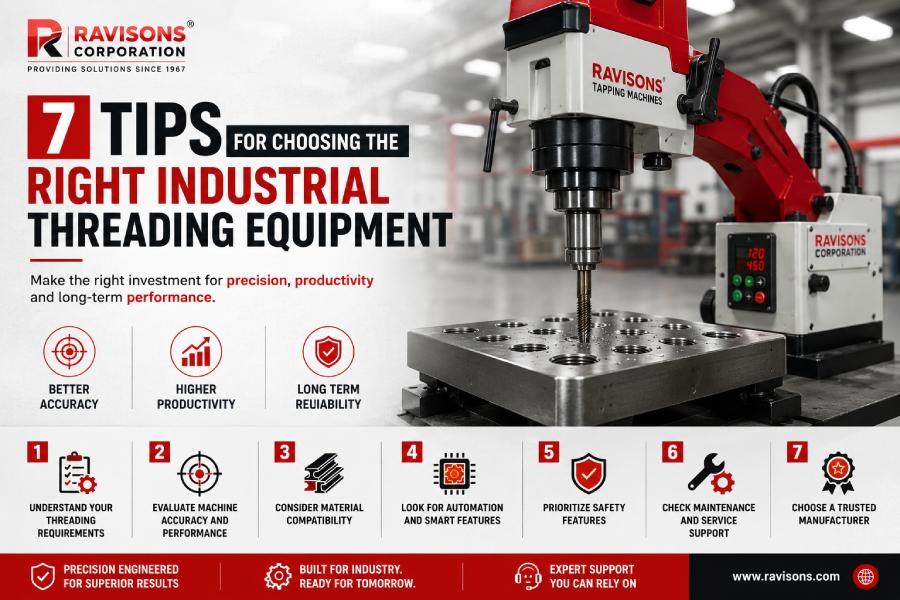
This guide explains seven practical tips that can help businesses select equipment that fits their production goals while avoiding common purchasing mistakes. Whether you operate a small fabrication workshop or manage a large manufacturing facility, these insights will help you make a more informed decision.
Why Choosing the Right Threading Equipment Matters
Threading may appear to be one small stage in the manufacturing process, but it has a significant influence on the overall quality of the finished product. Poorly cut threads can result in assembly failures, expensive rework, rejected parts, and dissatisfied customers.
Industrial production today demands consistency across thousands of identical components. Even slight variations in thread dimensions can create major issues during assembly.
High quality equipment helps manufacturers achieve
- Better thread accuracy
- Improved production speed
- Reduced operator fatigue
- Lower maintenance costs
- Longer tool life
- Better workplace safety
- Consistent product quality
Selecting the wrong equipment often leads to frequent machine stoppages, broken tooling, inconsistent threads, and increased production costs.
Instead of focusing only on purchase price, manufacturers should evaluate the total value the equipment provides over several years of operation.
Tip 1: Understand Your Threading Requirements Before Buying
Every manufacturing facility has unique production requirements. Purchasing equipment without first understanding those needs often results in unnecessary expenses or machines that cannot meet future demand.
Before comparing machines, consider several important questions.
What materials do you machine?
Different materials require different cutting characteristics.
For example:
- Mild steel
- Stainless steel
- Cast iron
- Brass
- Copper
- Aluminum
- Titanium alloys
Harder materials require higher torque and greater machine rigidity, while softer metals demand smooth control to avoid damaging the threads.
What thread sizes are produced?
Some manufacturers only produce smaller threaded holes, while others work on larger industrial components.
Machine capacity should comfortably support your smallest and largest production requirements without sacrificing accuracy.
What production volume do you expect?
Production quantity directly influences the type of equipment you should choose.
Low production environments may prioritize flexibility.
High volume production facilities often benefit from automated systems that improve consistency while reducing labor requirements.
Planning for future production growth is equally important. Purchasing equipment with slightly higher capacity today can prevent expensive upgrades later.
Tip 2: Evaluate Machine Accuracy and Performance
Accuracy is one of the most important characteristics of industrial threading equipment.
Even high quality cutting tools cannot compensate for poor machine alignment or unstable construction.
Reliable machines deliver repeatable results across hundreds or even thousands of production cycles.
Several design features contribute to consistent performance.
-
Strong Machine Construction
A rigid machine frame reduces vibration during operation.
Lower vibration helps produce cleaner threads while extending cutting tool life.
Stable construction also improves operator confidence during continuous production. -
Smooth Motion Control
Modern equipment uses advanced mechanisms that provide controlled spindle movement throughout the threading process.
Smooth movement prevents uneven thread formation and improves overall finish quality. -
Precision Components
High quality bearings, guide systems, and spindle assemblies maintain alignment over long periods of operation.
This reduces maintenance while preserving production accuracy.
A properly designed tapping machine should consistently produce threads that meet engineering specifications with minimal operator adjustments.
Tip 3: Consider Material Compatibility
Manufacturing environments rarely work with only one material.
A versatile machine should accommodate multiple metals while maintaining consistent thread quality.
- Material compatibility becomes especially important for job shops that serve different industries.
- Each material behaves differently during machining.
- Aluminum generates less cutting resistance but requires clean chip evacuation.
- Stainless steel creates greater cutting forces and generates more heat.
- Cast iron produces abrasive particles that demand durable machine components.
- Copper and brass require smooth cutting action to maintain thread quality.
The equipment should support appropriate cutting speeds, feed rates, lubrication methods, and tooling options for every material processed.
Choosing equipment with broad compatibility improves production flexibility while reducing future investment costs.
A well designed industrial tapping machine provides manufacturers with the ability to handle diverse production requirements without compromising efficiency.
Tip 4: Look for Automation and Smart Features
Modern manufacturing continues to move toward higher productivity through automation.
Automation not only increases production speed but also improves consistency across every component.
Many manufacturers now prefer machines equipped with intelligent features that simplify operation.
Useful automation features include:
-
Automatic Depth Control
Maintains identical thread depth throughout production.
-
Torque Protection
Prevents tap breakage by automatically responding to excessive cutting resistance.
-
Digital Controls
Allow operators to quickly adjust settings for different jobs without complicated mechanical changes.
-
Memory Functions
Store commonly used production settings for faster setup.
-
Safety Systems
Emergency stop controls, overload protection, and guarded moving components help create a safer working environment.
Advanced automation also reduces operator dependency, making production less vulnerable to human error.
Many facilities that invest in a drilling and tapping machine appreciate the ability to perform multiple machining operations within a single workflow. This improves productivity while reducing handling time between processes.
Tip 5: Check Machine Durability and Build Quality
Industrial equipment is expected to perform reliably under demanding production schedules. A machine that frequently breaks down or requires constant maintenance can quickly increase operating costs and disrupt delivery timelines. That is why build quality should be one of the most important considerations before making a purchase.
A durable machine offers consistent performance over several years while maintaining accuracy even during continuous operation. Manufacturers should carefully inspect the overall construction rather than focusing only on technical specifications.
Examine the Machine Frame
The frame acts as the foundation of the entire machine. A rigid and well engineered frame minimizes vibration, supports better alignment, and improves machining stability.
Machines built with high quality cast iron or heavy duty steel structures generally perform better under demanding industrial conditions. They also reduce wear on internal components, resulting in longer service life.
Inspect the Mechanical Components
The quality of gears, guide rails, bearings, and spindle assemblies directly affects long term performance.
Premium components provide:
- Better operational stability
- Lower maintenance requirements
- Reduced vibration
- Improved machining precision
- Longer tool life
Although high quality machines may require a larger initial investment, they often deliver a significantly lower cost of ownership over time.
Evaluate Safety Features
Safety should never be treated as an optional feature. Modern industrial equipment should include emergency stop buttons, overload protection, guarded moving parts, and user friendly controls that reduce the risk of workplace accidents.
A safer workplace also contributes to higher operator confidence and improved productivity.
Tip 6: Consider After Sales Service and Technical Support
Many buyers focus heavily on machine specifications while overlooking the importance of customer support. However, responsive after sales service often becomes just as valuable as the machine itself.
Even the best equipment requires periodic maintenance, spare parts, software updates, or technical assistance. Choosing a manufacturer that provides dependable support helps minimize production interruptions.
When evaluating a supplier, consider the following questions
-
Is Technical Assistance Easily Available?
Quick access to experienced service engineers can reduce downtime whenever unexpected issues arise.
Reliable technical support helps businesses resume production faster while avoiding costly delays. -
Are Spare Parts Readily Available?
Waiting weeks for replacement parts can bring production to a standstill.
Manufacturers with well established inventories and efficient logistics ensure faster repairs whenever components require replacement. -
Does the Company Offer Operator Training?
Proper operator training improves machine utilization, enhances safety, and reduces the chances of costly operating mistakes.
Training also enables employees to maximize the machine’s full capabilities. -
Is Preventive Maintenance Available?
Scheduled maintenance services help identify minor issues before they become major breakdowns.
Preventive maintenance increases equipment lifespan while reducing unexpected repair expenses.
Working with an experienced manufacturer creates a long term partnership rather than simply completing a one time purchase.
Tip 7: Compare the Total Cost Instead of Just the Purchase Price
Many buyers naturally compare equipment based on the initial selling price. While budget is certainly important, focusing only on the purchase cost can lead to expensive mistakes later.
The real value of industrial equipment is determined by its total cost throughout its operating life.
Factors that contribute to total ownership cost include:
- Energy consumption
- Maintenance expenses
- Spare part availability
- Tool life
- Machine reliability
- Operator productivity
- Downtime
- Expected service life
For example, a machine that costs slightly more initially may consume less electricity, require fewer repairs, and produce higher quality threads. Over several years, this can result in substantial savings.
A dependable thread tapping machine helps manufacturers reduce rejected parts, improve production consistency, and increase overall profitability.
Looking beyond the purchase price allows businesses to make investment decisions that deliver lasting value.
Common Mistakes to Avoid When Buying Industrial Threading Equipment
Even experienced buyers occasionally overlook important details during the purchasing process. Avoiding these common mistakes can help ensure a more successful investment.
-
Choosing Based Only on Price
The least expensive option is not always the most economical over the long term.
-
Ignoring Future Production Growth
Selecting equipment with limited capacity may require another investment sooner than expected.
-
Overlooking Technical Support
Reliable after sales service can significantly reduce downtime during the machine’s operating life.
-
Buying Without Understanding Production Needs
Every manufacturing facility has unique requirements. Equipment should match actual production goals rather than general specifications.
-
Neglecting Operator Training
Well trained operators achieve better productivity, higher safety, and longer machine life.
Pros and Cons of Investing in High Quality Industrial Threading Equipment
Pros
- Higher production accuracy
- Improved product consistency
- Longer equipment lifespan
- Better operator safety
- Reduced maintenance costs
- Faster production cycles
- Greater operational flexibility
- Lower rejection rates
- Improved return on investment
Cons
- Higher initial investment
- Operator training may be required
- Advanced models may include features unnecessary for very small workshops
- Regular preventive maintenance remains essential for optimal performance
Although premium equipment costs more initially, the long term operational benefits often outweigh the additional investment.
Conclusion
Choosing the right industrial threading equipment is a strategic decision that directly influences manufacturing quality, productivity, and long term business growth. Every production environment has unique requirements, making it essential to evaluate machine capabilities, build quality, automation features, service support, and overall operating costs before investing.
A well selected machine not only delivers accurate and repeatable threading but also helps reduce waste, improve workplace efficiency, and lower maintenance expenses over time. Instead of focusing solely on the purchase price, manufacturers should consider the long term value that reliable equipment brings to daily operations.
By following these seven practical tips, businesses can confidently invest in equipment that supports current production needs while remaining adaptable to future expansion. Careful planning today leads to greater operational efficiency, better product quality, and stronger returns for years to come.
FAQ’s
A tapping machine is designed to create internal threads inside pre drilled holes. It helps manufacturers achieve consistent thread quality while improving production efficiency across different industrial applications.
A drilling and tapping machine combines two machining operations into a single workflow. This reduces handling time, improves productivity, increases accuracy, and helps streamline manufacturing processes.
Routine preventive maintenance based on the manufacturer’s recommendations helps maintain accuracy, extend machine life, reduce downtime, and improve overall productivity.