
Table of Contents
ToggleIntroduction
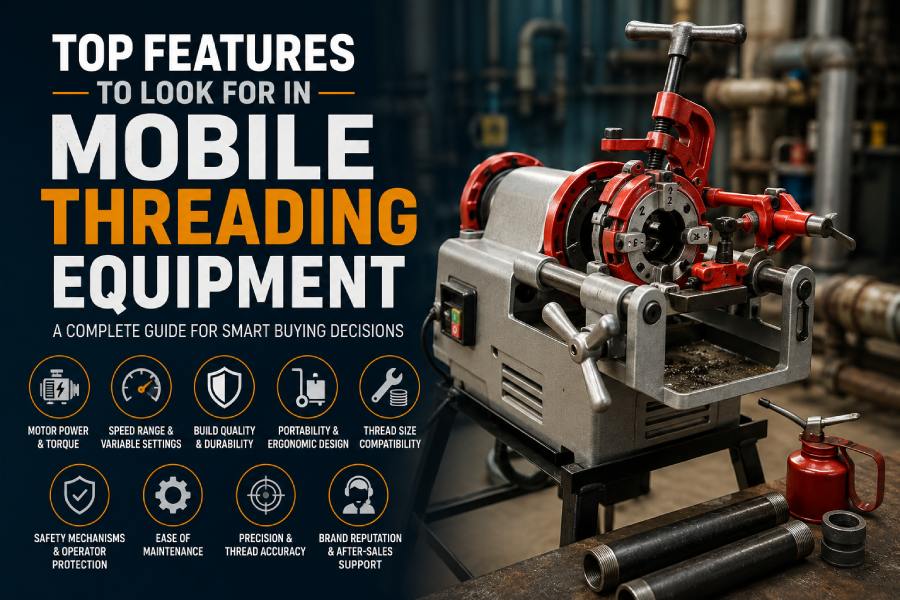
Whether you are running a busy pipe fitting workshop, managing on-site plumbing installations, or handling industrial maintenance jobs, having the right threading equipment in your toolkit can make or break your productivity. Mobile threading machines have become a go-to solution for professionals who need reliable, accurate, and efficient threading on the move. If you have been searching for a dependable solution, a portable tapping machine gives you the flexibility to handle threading tasks directly at the job site without sacrificing precision or power.
But with so many options flooding the market today, how do you separate the truly capable machines from the ones that will let you down mid-job? This guide breaks down every essential feature you should evaluate before making a purchase, so you walk away with a machine built to meet your real-world demands.
Why Mobile Threading Equipment Matters in Modern Industry
The shift toward on-site work in construction, plumbing, oil and gas, and general fabrication has created a strong demand for compact yet powerful threading tools. Workers no longer have the luxury of carrying every job back to a fixed workshop. Speed, accuracy, and mobility are now equally important.
Modern mobile threading machines have evolved significantly. Today’s units offer industrial-grade performance in a form factor that one person can transport, set up, and operate without requiring heavy infrastructure. The key is knowing what separates a high-performing unit from a machine that looks capable on paper but underdelivers in the field.
Feature 1: Motor Power and Torque Capacity
Motor power is the backbone of any tapping machine. Insufficient torque leads to poor thread quality, machine overheating, and premature wear. When evaluating mobile threading equipment, look for machines with motors that deliver consistent torque across a range of pipe sizes and materials.
For general-purpose industrial use, a motor rating between 750W and 2000W typically covers most applications. For heavy-duty work involving larger diameter pipes or harder materials like stainless steel, opt for higher wattage with a robust copper-wound motor.
Key things to check:
- Continuous duty rating vs peak power (continuous is more reliable)
- Thermal overload protection to prevent burnout
- Compatibility with both 220V single-phase and three-phase power supplies depending on your setup
A machine with good torque at low RPMs is especially valuable for threading larger pipe sizes where controlled, steady cutting produces cleaner threads.
Feature 2: Speed Range and Variable Settings
Not every threading job is the same. Threading a half-inch pipe requires a different speed setting compared to working on a two-inch or four-inch pipe. A quality industrial tapping machine should offer multiple speed settings or a variable speed control system that allows the operator to dial in the right RPM for each job.
Variable speed capability directly impacts:
- Thread quality and surface finish
- Tool life and die longevity
- Operator control during difficult cuts
Look for machines that clearly indicate RPM ranges for each speed setting. Ideally, the speed adjustment mechanism should be easy to access without tools, allowing quick changes between jobs on a busy site.
Feature 3: Build Quality and Durability
Mobile threading equipment takes a beating. It travels between job sites, gets exposed to cutting oil, vibration, metal chips, and sometimes rough handling. A machine built with inferior materials will develop play in its components quickly, compromising thread accuracy and creating safety risks.
What to look for in build quality:
- Die head material: Cast iron or high-grade alloy heads hold dimensional accuracy far longer than cheaper alternatives
- Carriage and chuck construction: Should be precision-machined with minimal runout
- Housing and body: Heavy-gauge steel enclosures resist dents and impacts better than thin sheet metal or plastic covers
- Sealing and dust protection: Enclosed gear drives protect against metal chip ingress that accelerates wear
A well-built drilling and tapping machine will maintain its calibration over thousands of cycles, which is directly tied to consistent thread quality across the life of the tool.
Feature 4: Portability and Ergonomic Design
The whole premise of mobile threading equipment is that it goes where the work is. But portability is more than just weight. A machine that is light but awkward to carry, set up, or position can be more frustrating than a heavier, well-designed unit.
Ergonomic considerations include:
- Integrated carry handles positioned for balanced transport
- Compact footprint that fits into tight spaces on-site
- Quick-release clamping systems that mount securely to pipes without excessive effort
- Foldable or detachable stands for stable floor operation
- Weight distribution that reduces operator fatigue during prolonged use
Machines in the 15 to 30 kg range with good handle placement tend to hit the sweet spot between portability and performance for most professional applications. If the unit ships with a purpose-built trolley or carry case, that is a strong indicator the manufacturer has thought through real-world transport.
Feature 5: Thread Size Compatibility and Versatility
A machine that can only handle a narrow range of thread sizes limits your operational flexibility. Look for a thread tapping machine that covers BSP, NPT, and metric thread standards across a wide size range, ideally from 1/8 inch through 4 inches or beyond.
Versatility factors to evaluate
- Number of thread standards supported (BSP, NPT, BSPT, metric)
- Die head compatibility with third-party dies for cost-effective replacements
- Quick-change die head systems that cut changeover time between thread sizes
- Ability to cut right-hand and left-hand threads
- Reamer and pipe cutter attachments for all-in-one pipe preparation
The more versatile the machine, the better your return on investment, especially for contractors who work across multiple industries or project types.
Feature 6: Safety Mechanisms and Operator Protection
Safety is non-negotiable in any industrial environment. Mobile threading machines operate with significant torque, sharp cutting dies, and slippery cutting oil. The right safety features protect operators from injury and protect the machine from damage caused by operator error.
Essential safety features include
- Automatic chuck release on overload to prevent injuries if the workpiece jams
- Foot switch or two-hand start controls to keep hands clear of the cutting zone
- Oil splash guards that contain cutting fluid during operation
- Emergency stop buttons that are easy to locate and reach
- Non-slip base feet or clamping provisions that prevent machine movement during use
- Overload protection on the motor to prevent electrical failures
Do not treat safety features as optional extras. Machines without adequate protection create liability risks and increase the likelihood of costly downtime due to accidents or equipment damage.
Feature 7: Ease of Maintenance and Spare Parts Availability
Even the most reliable machine needs periodic maintenance. Cutting dies wear out, oil needs changing, chucks need cleaning, and mechanical components require lubrication. A machine that is difficult to service or relies on obscure proprietary parts can quickly become an expensive paperweight.
Maintenance-friendly design features to look for
- Easy-access oil drain and fill points for gear oil changes
- Standardized die head sizes compatible with widely available replacement dies
- Removable chip tray or chip collection system for fast cleanup
- Clearly marked lubrication points in the user manual
- Service network or authorized service centers in your region
When evaluating brands, research spare parts lead times and local service availability. A machine supported by a responsive manufacturer with a strong spare parts supply chain will deliver a much lower total cost of ownership over its working life.
Feature 8: Precision and Thread Accuracy
All the portability and power in the world means nothing if the threads produced are not accurate enough to form a reliable seal or joint. Precision in threading equipment comes from the quality of the die head, the rigidity of the carriage, and the accuracy of the feed mechanism.
Precision indicators to check
- Die head runout tolerance (lower is better; look for less than 0.05mm)
- Carriage travel smoothness without binding or play
- Automatic die head opening at the end of the thread to prevent back-cut damage
- Consistent thread taper on NPT and BSPT profiles across multiple cycles
It is worth asking manufacturers for tolerance specifications in writing. Machines intended for gas line or hydraulic applications must meet tighter standards than those used for basic plumbing, and the specification sheet will tell you whether a given machine is genuinely up to the task.
Feature 9: Brand Reputation and After-Sales Support
Buying from a reputable manufacturer is one of the smartest decisions you can make when investing in threading equipment. Established brands with a proven track record in industrial markets tend to offer better build quality, more reliable performance, and stronger after-sales support than unknown alternatives competing purely on price.
What good after-sales support looks like
- Warranty coverage of at least 12 months on parts and labor
- Responsive technical support via phone or email
- Availability of video tutorials and detailed user manuals in your language
- Access to genuine replacement parts without long lead times
- A network of authorized dealers or service agents in your region
Reading verified user reviews on industrial forums and procurement platforms gives you a realistic picture of how a brand performs after the sale. Pay particular attention to how manufacturers respond to complaints or warranty claims.
Pros and Cons of Mobile Threading Equipment
Pros
- Enables on-site threading without transporting pipes to a fixed workshop
- Saves significant labor time on large-scale installations
- Modern units deliver precision comparable to stationary machines
- Versatile across multiple thread standards and pipe sizes
- Reduces material handling risk and potential for pipe damage during transport
Cons
- Higher upfront cost compared to manual threading tools
- Requires regular maintenance to sustain performance
- Heavier units may still need two-person operation for transport
- Cutting oil management on-site can be messy without proper containment
- Electrical supply requirements may limit use in remote locations without a generator
Conclusion
Choosing the right mobile threading equipment is a decision that directly affects your productivity, job quality, and long-term costs. From motor power and build quality to safety features and brand support, every element covered in this guide plays a real role in how the machine performs when it matters most.
The best threading machines combine durability, precision, versatility, and genuine portability, giving professionals the confidence to take on any threading task, anywhere, without compromise. Take time to compare specifications carefully, test machines where possible before purchasing, and always factor in the full cost of ownership rather than just the upfront price.
FAQ’s
Most professional-grade tapping machines support BSP (British Standard Pipe), NPT (National Pipe Thread), BSPT (British Standard Pipe Taper), and metric thread standards. The range of pipe sizes covered varies by model, but most mid-range units handle sizes from 1/8 inch up to 2 inches, with heavy-duty models extending to 4 inches or larger.
Start by identifying the pipe sizes and thread standards you work with most frequently. Then consider your operating environment, whether you need the machine on job sites or in a workshop, and what power supply is available. Motor power, die head quality, and brand support should all factor into your decision. Matching the machine specifications to your actual workload prevents both underpowering and unnecessary overspending.
Most reputable machines use standardized die head sizes that are compatible with dies from multiple manufacturers. Using high-quality third-party dies is generally acceptable and can reduce running costs. However, always verify compatibility before purchasing aftermarket dies, as using incorrect sizes or poor-quality dies can damage the die head and compromise thread quality.
Ready to Thread Smarter on Every Job Site?
Stop settling for equipment that slows you down or leaves you short on-site. Whether you are outfitting a new workshop or replacing aging tools, investing in the right threading machine pays dividends on every single project.