
Table of Contents
ToggleIntroduction
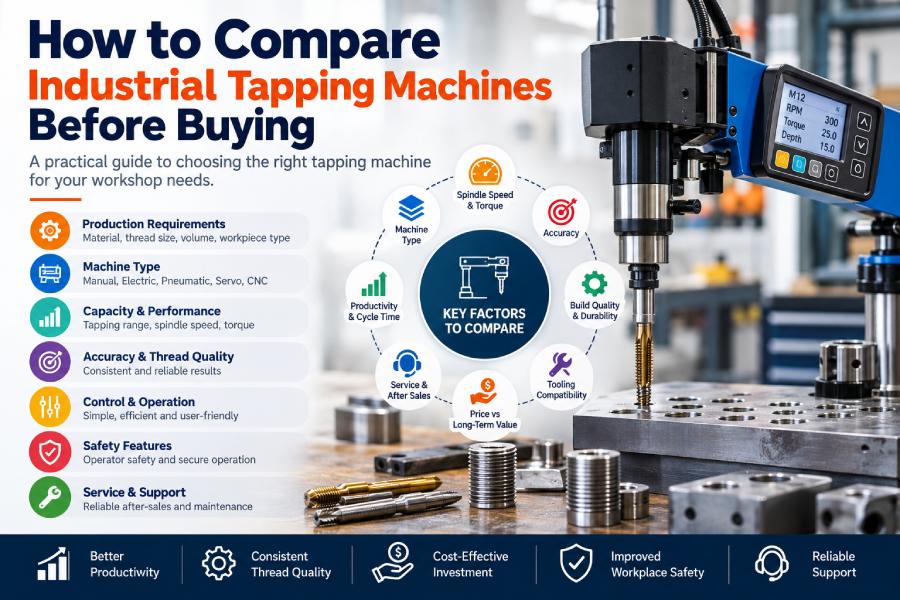
Choosing the right machine can make a noticeable difference to production speed, thread quality, operator effort, and long term operating costs. When evaluating Tapping Machine Suppliers, buyers should look beyond the quoted price and compare the machine against their actual production requirements. This guide explains what to check before purchasing, from capacity and torque to accuracy, controls, tooling, safety, maintenance, and after sales support.
An industrial tapping machine is not simply another piece of workshop equipment. It becomes part of the production process. A machine that looks affordable initially may become expensive if it cannot handle your components efficiently. Likewise, paying more for features you never use does not automatically make a machine a better investment.
The smarter approach is to compare machines against measurable requirements.
Why Comparing Tapping Machines Matters
Industrial tapping requirements can vary considerably from one workshop to another. One manufacturer may need high speed tapping for large production batches. Another may need flexibility for different thread sizes and workpieces.
Before comparing individual models, identify what matters most for your operation.
A good comparison should consider
- Thread sizes you commonly produce
- Material being tapped
- Required production volume
- Workpiece dimensions
- Desired tapping speed
- Required thread accuracy
- Operator skill level
- Available floor space
- Power requirements
- Maintenance requirements
- Tooling compatibility
- Service availability
This prevents a common purchasing mistake: choosing a machine because its specification sheet looks impressive without checking whether those specifications actually matter to the application.
Start With Your Actual Production Requirements
Before contacting manufacturers or requesting quotations, make a basic production profile.
Write down:
Material: Steel, aluminium, brass, cast iron, or other materials.
Thread range: List the smallest and largest thread sizes you expect to produce.
Production volume: Estimate the number of components requiring tapping per shift or month.
Workpiece size: Record approximate dimensions and weight.
Hole type: Identify whether the operation involves through holes, blind holes, or both.
Accuracy: Determine the level of thread consistency your application requires.
This information gives you a practical baseline for comparing machines.
Check the Machine Type
Not every tapping machine is designed for the same production environment.
Depending on the application, you may encounter
- Manual tapping machines
- Electric tapping machines
- Pneumatic tapping machines
- Servo tapping machines
- CNC tapping machines
- Automatic tapping systems
- Flexible arm tapping machines
- Vertical tapping machines
The right choice depends on the work rather than the machine’s feature list.
For example, a workshop handling different component sizes may value flexibility. A high volume production line may place greater emphasis on automation, repeatability, and cycle time.
Industrial Tapping Machine Selection Starts With the Application
A useful rule is simple:
Choose the machine around the job, not the job around the machine. If your production involves frequent changes in thread size, setup flexibility may be particularly important.
If your operation focuses on repetitive production, speed and consistency may have greater value.
Compare Tapping Capacity
Tapping capacity is one of the first specifications you should examine. Do not simply look at the maximum advertised thread size. Check whether the machine can comfortably handle the thread range you actually use.
Consider
- Minimum thread size
- Maximum thread size
- Material being tapped
- Blind hole capability
- Through-hole capability
- Recommended tapping range
- Applicable tap types
For example, a machine advertised for a particular maximum thread size may not necessarily deliver the same performance across every material.
Ask the manufacturer which thread sizes are recommended for your specific application.
Look at Spindle Speed and Torque
Speed gets plenty of attention when machines are compared, but torque is equally important.
A tapping machine needs sufficient torque to drive the tool through the material without compromising the operation.
Compare these specifications
| Specification | Why It Matters |
|---|---|
| Spindle speed | Influences tapping cycle time |
| Torque | Determines the machine’s ability to handle resistance |
| Motor power | Indicates available drive capability |
| Speed range | Helps accommodate different materials and thread sizes |
| Speed control | Provides greater control during operation |
Higher speed is not automatically better.
The appropriate speed depends on factors such as
- Material
- Thread size
- Tap geometry
- Hole depth
- Cutting conditions
- Lubrication
- Required thread quality
A useful machine comparison therefore considers speed and torque together.
Evaluate Accuracy and Thread Quality
Consistent threads are essential in many manufacturing applications. A machine should provide controlled movement and repeatable tapping performance.
When comparing models, ask about:
- Spindle alignment
- Thread depth control
- Reversal mechanism
- Repeatability
- Tapping consistency
- Chuck or tool holding system
- Blind hole performance
Why Repeatability Matters
Imagine producing hundreds of components where every tapped hole needs to accept a mating fastener. A small inconsistency repeated across a large batch can create quality problems.
This is why accuracy should not be treated as a secondary specification. Ask for practical performance information instead of relying only on broad claims.
Understand Control and Operation Features
Modern machines can offer different levels of operator control. Some operations may benefit from straightforward controls. Others may require more advanced programmable functions.
Check whether the machine offers
- Variable speed control
- Adjustable tapping depth
- Programmable settings
- Digital displays
- Automatic spindle reversal
- Preset operating parameters
- Easy-to-use controls
A machine with advanced controls can be useful, but complexity also matters. If operators need extensive training for a task that could be handled more simply, the extra features may not provide meaningful value.
The best setup is one that gives operators the control they need without unnecessary complexity.
Check Workpiece Compatibility
The machine must suit the components you actually manufacture.
Look at
- Workpiece dimensions
- Component weight
- Fixture requirements
- Table size
- Working area
- Spindle reach
- Vertical clearance
- Arm movement, where applicable
This is particularly important when working with irregular or larger components.
A machine may have excellent tapping specifications but still be unsuitable if the component cannot be positioned comfortably.
Ask a Practical Question
Before buying, ask
Can my operator place, align, tap, remove, and repeat the component efficiently?
If the answer is no, the machine may not be suitable regardless of its technical specifications.
Compare Productivity and Cycle Time
Productivity is more than spindle speed.
Consider the complete tapping cycle.
A useful comparison includes
- Component positioning
- Tool alignment
- Tapping operation
- Spindle reversal
- Tool withdrawal
- Component removal
- Setup between batches
Reducing unnecessary handling can sometimes create a larger productivity improvement than simply increasing spindle speed.
Look for productivity features such as
- Quick setup
- Easy component positioning
- Fast spindle reversal
- Simple depth adjustment
- Efficient tool changes
- Repeatable operation
- Reduced operator fatigue
This gives you a more realistic picture of production capacity.
Do Not Ignore Machine Construction
The structure of the machine can affect stability, durability, and long term performance.
When inspecting a machine, pay attention to:
- Frame construction
- Spindle assembly
- Bearings
- Moving components
- Table design
- Arm structure
- Motor and drive system
- Overall build quality
A stable machine can help reduce unwanted movement during operation.
Do not judge construction only by appearance. Ask about materials, manufacturing practices, maintenance requirements, and expected operating conditions.
Consider Tooling and Chuck Compatibility
The tapping tool is directly involved in the cutting process, so compatibility matters.
Check
- Tap holder type
- Chuck compatibility
- Quick-change options
- Tool size range
- Floating or compensation features, if applicable
- Availability of replacement tooling
A machine can become inconvenient if suitable tooling is difficult to source. Before purchasing, confirm which tools and holders are supported and whether they are readily available for your production requirements.
Evaluate Safety Features
Safety should be part of the buying decision, not an afterthought. Operators work around rotating equipment, cutting tools, workpieces, and moving machine components.
Depending on the machine design, look for appropriate features such as
- Emergency stop controls
- Protective guarding
- Controlled spindle movement
- Secure workholding
- Clear operator controls
- Safe tool changing procedures
- Appropriate electrical protection
Operators should also receive proper training and follow the manufacturer’s operating instructions. A productive machine is only useful when it can be operated safely and consistently.
Compare Service and After Sales Support
The purchase does not end when the machine arrives at your facility. Service support can become extremely important when production depends on the equipment.
Ask potential suppliers
- Is installation support available?
- Is operator training provided?
- How quickly can service issues be addressed?
- Are spare parts readily available?
- What is the warranty coverage?
- Is technical support available?
- Can preventive maintenance be supported?
- How are replacement components sourced?
A lower purchase price may not represent better value if obtaining technical assistance takes too long.
For production environments, downtime has a cost.
Think Beyond the Purchase Price
The cheapest quotation is not always the lowest-cost option.
Consider the machine’s total cost of ownership.
This can include:
- Purchase price
- Installation
- Tooling
- Electricity
- Maintenance
- Spare parts
- Operator training
- Downtime
- Repairs
- Productivity
- Expected service life
Pros and Cons of Different Buying Approaches
Choosing the Lowest-Priced Machine
Pros
- Lower initial investment
- Easier to fit into a tight budget
- Suitable for basic applications
Cons
- May have fewer features
- Potentially limited capacity
- Service support may vary
- Could become restrictive as production grows
Choosing the Most Advanced Machine
Pros
- More control options
- Greater automation potential
- Suitable for demanding applications
- May support future production needs
Cons
- Higher initial investment
- More operator training may be required
- Some features may remain unused
Choosing Based on Application Fit
Pros
- Better alignment with production needs
- Easier operator adoption
- More predictable performance
- Better long term value
Cons
- Requires more research
- May require application discussions before purchase
For most workshops, application fit is a stronger decision factor than simply choosing the cheapest or most advanced option.
Tapping Machine Buying Checklist
Before finalising your purchase, run through this quick checklist.
Technical
- Required thread range confirmed
- Suitable tapping capacity
- Appropriate spindle speed
- Sufficient torque
- Suitable motor power
- Required depth control
- Compatible tooling
Production
- Workpiece dimensions fit
- Expected cycle time reviewed
- Production volume considered
- Setup time evaluated
- Operator workflow checked
Commercial
- Machine price compared
- Installation costs checked
- Tooling costs included
- Warranty reviewed
- Spare parts availability confirmed
- Service support discussed
Safety
- Emergency stop available
- Appropriate guarding considered
- Workholding reviewed
- Operator training available
This checklist can make it much easier to compare multiple quotations without getting distracted by specifications that do not affect your application.
Conclusion
Buying a tapping machine should not come down to one number on a quotation. The right choice comes from comparing the machine’s capabilities with the work it will actually perform.
Before making a decision, review:
- Tapping capacity
- Spindle speed
- Torque
- Accuracy
- Workpiece compatibility
- Productivity
- Machine construction
- Tooling
- Safety
- Service support
- Total ownership cost
A careful comparison can help you avoid paying for unnecessary features while also preventing the bigger mistake of choosing equipment that cannot keep up with your production requirements.
The best machine is ultimately the one that delivers the right combination of performance, reliability, operator convenience, and long term value for your workshop.
FAQ’s
Consider tapping capacity, thread sizes, materials, speed range, torque control, depth control, operator ergonomics, safety features, maintenance requirements and technical support.
Make your next tapping machine purchase with greater confidence.