
Introduction
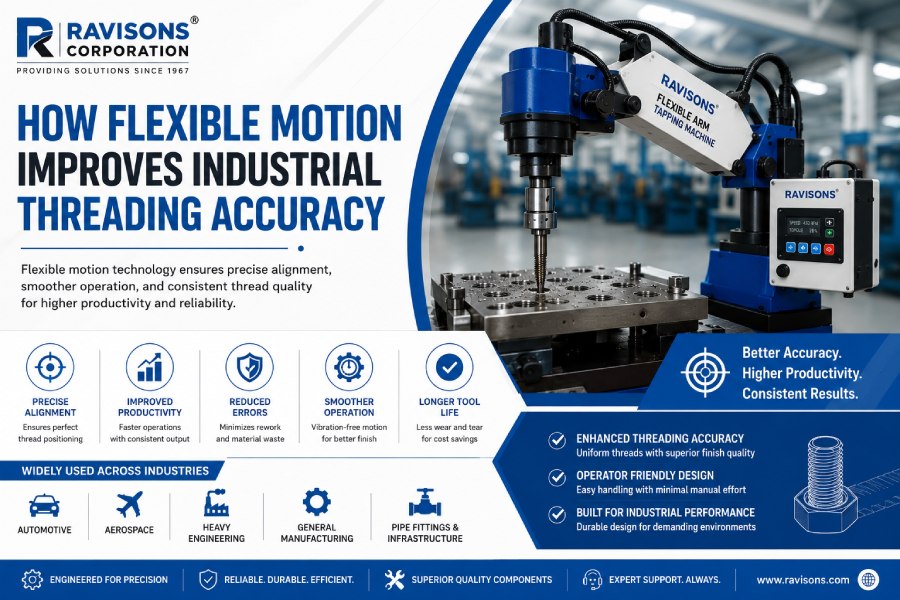
Every manufacturing business strives for one thing, consistent quality. Whether producing automotive components, heavy machinery, aerospace parts, or custom metal products, accurate threads determine how well a finished product performs in real world applications. Investing in a reliable Flexible Arm Tapping Machine can significantly improve precision while reducing manual effort and production errors.
Manufacturers today face increasing pressure to produce more components without compromising quality. Customers expect perfect fitment, minimal defects, and shorter delivery times. Even a minor threading mistake can result in rejected parts, costly rework, production delays, or equipment failures after installation.
Modern motion assisted equipment has transformed the way industries create threads by improving operator control, maintaining alignment, and reducing unwanted movement during machining operations. Instead of depending entirely on operator skill, advanced designs support smooth movement that naturally follows the workpiece, helping deliver consistent results across different production environments.
In this article, you’ll discover how flexible motion improves threading accuracy, why it matters for modern industries, and what factors contribute to producing reliable, repeatable threads every time.
Why Threading Accuracy Matters in Manufacturing
Threading is much more than cutting grooves into a hole. Every thread must match exact engineering specifications to ensure proper assembly, load distribution, sealing performance, and long service life.
Poor threading accuracy may lead to
- Loose fasteners
- Cross threading
- Component failures
- Increased vibration
- Product recalls
- Safety concerns
- Higher manufacturing costs
Industries that manufacture high precision components cannot afford these problems. A single defective thread can affect the performance of an entire assembly.
Accurate threading also contributes to smoother production workflows. When every threaded component fits correctly the first time, assembly lines move faster, inspection becomes easier, and customer satisfaction improves.
Understanding Flexible Motion in Modern Workshops
Traditional fixed setups often require operators to carefully align tools before every operation. Although experienced machinists can achieve excellent results, repetitive adjustments consume valuable production time.
Flexible motion introduces controlled movement that allows the equipment to naturally position itself according to the workpiece. Instead of forcing perfect manual alignment every time, the mechanism compensates for slight positional variations while maintaining precision.
This controlled movement offers several advantages.
-
Better Tool Alignment
Proper alignment reduces the chances of tilted threads. Straight entry into the workpiece creates cleaner threads with uniform depth and pitch.
-
Reduced Operator Fatigue
When operators spend less time making constant adjustments, they can focus more on maintaining production quality and inspecting finished components.
-
Consistent Results
Production consistency becomes easier to maintain because the equipment supports repeatable positioning throughout long manufacturing cycles.
Key Factors That Affect Thread Quality
Several variables influence threading accuracy. Understanding these factors helps manufacturers improve both productivity and product quality.
Material Properties
- Different materials behave differently during machining.
- Soft metals may produce long chips that interfere with cutting.
- Hard materials require greater cutting force and careful lubrication.
- Some alloys generate higher temperatures, increasing tool wear.
Selecting proper cutting parameters helps maintain consistent thread quality across various materials.
Tool Condition
- Worn cutting tools often create rough surfaces, inaccurate thread profiles, and dimensional variation.
- Routine inspection allows manufacturers to replace worn tooling before product quality begins to decline.
Preventive maintenance remains significantly less expensive than scrapping finished components.
Machine Stability
- Vibration directly impacts machining accuracy.
- Stable equipment minimizes unwanted movement during cutting, resulting in smoother thread surfaces and improved dimensional consistency.
Rigid construction also extends tool life by reducing unnecessary stress during operation.
Operator Technique
- Even advanced equipment benefits from skilled operators.
- Proper speed selection, lubrication practices, inspection methods, and workpiece positioning all contribute to higher quality threaded components.
Training remains an important investment for every manufacturing facility.
How Flexible Movement Enhances Precision
One of the biggest advantages of flexible motion is its ability to maintain natural alignment throughout the threading process.
Instead of forcing rigid positioning, controlled movement follows the workpiece more naturally while maintaining cutting accuracy.
This creates several practical benefits.
-
Lower Side Loading
Excessive sideways pressure increases tool wear and reduces thread quality.
Smooth movement minimizes unnecessary stress on the cutting tool, allowing cleaner engagement throughout the operation. -
Improved Surface Finish
Stable cutting action produces cleaner thread surfaces with fewer imperfections.
Better surface finish often improves assembly performance while reducing friction during fastening. -
Higher Repeatability
Manufacturers producing hundreds or thousands of identical components rely on repeatable accuracy.
Consistent positioning reduces variation between parts, making quality control easier and reducing production waste. -
Reduced Rework
Every rejected component represents lost material, machining time, inspection effort, and labor costs.
Improved positioning significantly reduces defects caused by poor alignment, helping manufacturers lower overall production expenses.
The Role of Intelligent Equipment in Manufacturing
Modern production facilities increasingly rely on automation, precision engineering, and smart manufacturing practices.
Today’s tapping machine solutions incorporate improved ergonomics, smoother motion systems, enhanced safety features, and better operational efficiency compared to older manual setups.
Many manufacturers also combine a drilling and tapping machine within their production workflow to reduce setup changes and improve machining efficiency for complex components.
As production volumes continue to increase, selecting an advanced industrial tapping machine capable of delivering repeatable accuracy becomes essential for maintaining consistent product quality.
Likewise, every thread tapping machine used in high volume manufacturing benefits from proper alignment, preventive maintenance, and operator training to maximize productivity while minimizing defects.
Industries That Benefit from Improved Threading Accuracy
Flexible motion technology supports a wide range of manufacturing sectors where precision is critical.
-
Automotive Manufacturing
Automotive components require reliable threaded connections for engines, transmissions, braking systems, and suspension assemblies.
Consistent threading helps improve vehicle safety and long term durability. -
Aerospace Engineering
Aircraft components demand extremely tight tolerances.
Even small deviations can affect assembly performance, making precise threading an essential part of aerospace manufacturing. -
Heavy Engineering
Large industrial equipment contains numerous threaded connections exposed to vibration and heavy loads. Accurate machining improves equipment reliability while reducing maintenance requirements.
-
Fabrication Workshops
Custom fabrication businesses often work with varying component sizes.
Flexible movement makes handling different workpieces faster and more efficient while maintaining quality.
Additional Benefits of Flexible Motion in Industrial Threading
Manufacturers are constantly looking for practical ways to improve efficiency without sacrificing quality. While precision remains the primary goal, flexible motion also delivers several operational benefits that directly impact production costs and workflow.
Faster Production Cycles
Time plays a major role in manufacturing profitability. Equipment that requires fewer adjustments between operations allows operators to complete more work in less time.
Because flexible movement naturally adapts to the position of the workpiece, setup time is reduced. Operators can transition between components more efficiently, especially in environments where different part sizes are processed throughout the day.
Higher productivity does not simply mean producing more parts. It also means maintaining consistent quality while meeting demanding production schedules.
Improved Operator Safety
Manufacturing facilities continue to prioritize workplace safety. Equipment that minimizes awkward positioning and repetitive movements helps create a safer working environment.
Flexible motion allows smoother handling during threading operations, reducing excessive force and lowering the physical strain placed on operators.
When employees are comfortable, they are more likely to maintain consistent performance throughout long production shifts.
Lower Maintenance Costs
Unexpected downtime can be one of the most expensive challenges in manufacturing.
Proper alignment reduces unnecessary stress on tooling and machine components, helping extend their service life.
Lower wear means
- Fewer tool replacements
- Reduced maintenance expenses
- Less unplanned downtime
- Better production planning
- Improved return on investment
Flexible Motion Compared with Traditional Fixed Systems
| Feature | Flexible Motion | Traditional Fixed Setup |
|---|---|---|
| Tool Alignment | Automatically adapts during operation | Requires frequent manual adjustments |
| Operator Fatigue | Lower | Higher |
| Production Speed | Faster | Moderate |
| Thread Consistency | Highly repeatable | Depends heavily on operator skill |
| Tool Wear | Lower | Higher |
| Production Errors | Reduced | More common |
| Ease of Handling Different Parts | Excellent | Limited |
Although both methods can produce quality results, flexible motion provides greater consistency while simplifying everyday production tasks.
Best Practices for Achieving Better Threading Accuracy
Even advanced equipment performs best when supported by good manufacturing practices.
Choose the Right Cutting Speed
Different materials require different machining speeds.
Running too fast may increase heat generation and accelerate tool wear, while operating too slowly can reduce productivity.
Following recommended machining parameters helps achieve the best balance between efficiency and quality.
Inspect Cutting Tools Regularly
Cutting tools gradually lose their sharpness after repeated use.
Routine inspections help identify worn tooling before it begins affecting thread quality.
Replacing tools at the appropriate time prevents unnecessary scrap and maintains dimensional accuracy.
Use Proper Lubrication
Lubrication plays an important role during threading operations.
A suitable cutting fluid helps
- Reduce friction
- Lower operating temperature
- Improve surface finish
- Extend tool life
- Produce cleaner threads
Choosing the correct lubricant depends on the workpiece material and machining conditions.
Secure the Workpiece Correctly
- Even small amounts of movement during machining can affect thread quality.
- Proper clamping improves stability and minimizes vibration throughout the operation.
- A secure workpiece also contributes to safer machining conditions.
Train Operators Regularly
Technology continues to evolve, and ongoing training ensures operators understand the latest machining techniques, maintenance procedures, and safety practices.
Experienced operators are better equipped to recognize potential issues before they affect production quality.
The Future of Industrial Threading
Manufacturing continues to move toward greater automation and smarter production systems.
Modern workshops are increasingly adopting solutions that combine precision engineering with improved ergonomics and digital monitoring.
Future developments are expected to include
- Smarter process monitoring
- Improved motion control systems
- Better energy efficiency
- Increased automation
- Predictive maintenance capabilities
- Enhanced production data analysis
As manufacturing standards continue to rise, businesses that invest in advanced threading solutions will be better positioned to deliver consistent quality while remaining competitive.
Pros and Cons
Pros
- Produces highly accurate threads
- Reduces alignment errors
- Improves production consistency
- Minimizes operator fatigue
- Helps extend tool life
- Lowers production waste
- Supports faster workflow
- Suitable for multiple industries
Cons
- Higher initial investment than basic manual equipment
- Operators may require training to maximize performance
- Regular maintenance is still necessary for long term reliability
Conclusion
Accurate threading is essential for manufacturing reliable products that meet modern quality standards. Every stage of the machining process, from tool condition to workpiece stability, influences the final result.
Flexible motion has become an important advancement because it improves alignment, reduces unnecessary tool stress, enhances repeatability, and supports consistent production across a wide range of industrial applications.
Manufacturers that prioritize precision often experience lower rejection rates, improved productivity, reduced maintenance costs, and better customer satisfaction. As production demands continue to evolve, adopting smarter machining solutions is no longer just an advantage. It has become an important part of maintaining quality and competitiveness.
FAQ’s
A tapping machine is designed to create internal threads inside pre drilled holes. It helps manufacturers produce precise and consistent threaded components for industries such as automotive, aerospace, heavy engineering, fabrication, and general manufacturing.
A drilling and tapping machine combines drilling and threading operations into a streamlined workflow. This reduces setup time, improves productivity, minimizes handling between operations, and supports consistent machining quality.
An industrial tapping machine is built to handle continuous production while maintaining high accuracy. It reduces manual effort, improves repeatability, and helps manufacturers achieve consistent thread quality across large production batches.
A thread tapping machine improves alignment and cutting stability, which helps minimize cross threading, damaged threads, and dimensional inconsistencies. Regular maintenance and proper operating practices further improve machining accuracy.
Manufacturers should evaluate production volume, material type, required thread sizes, machine stability, ease of operation, maintenance requirements, and long term reliability. Choosing equipment that matches production needs helps improve efficiency and maintain consistent product quality.
Experience greater accuracy, smoother operations, and dependable performance with advanced threading technology built for modern manufacturing.