
Table of Contents
ToggleIntroduction
Every manufacturing unit aims to produce components that meet strict quality standards while maintaining speed and efficiency. One of the most important decisions in achieving this goal is selecting the right threading equipment for your production line. Whether you manufacture automotive parts, industrial machinery, aerospace components, or fabricated metal products, investing in the correct equipment directly affects product quality and operating costs.
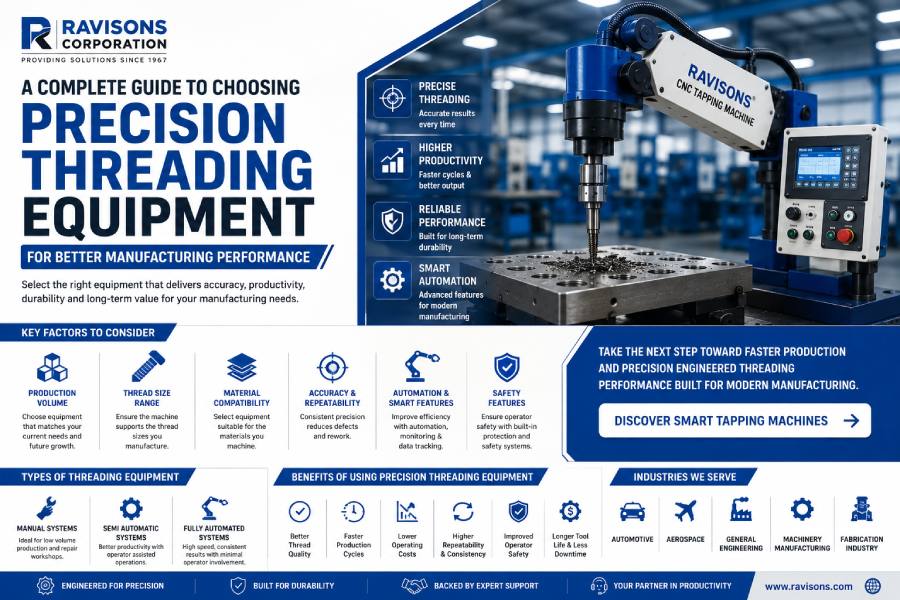
If you are exploring a reliable Cnc Tapping Machine for your production requirements, understanding the factors behind equipment selection will help you make a smarter investment. Instead of focusing only on price, it is important to evaluate precision, productivity, durability, automation capabilities, maintenance requirements, and long term value.
This guide explains everything you should know before selecting precision threading equipment. By the end, you will understand how different features contribute to manufacturing efficiency and how to choose equipment that supports your business for years to come.
Why Precision Threading Equipment Matters
Threading is one of the most important machining operations across numerous industries. Every threaded hole must meet dimensional accuracy, proper alignment, and consistent quality. Even minor deviations can affect assembly, reduce product reliability, and increase rejection rates.
Precision equipment offers several advantages
- Better thread quality
- Reduced material waste
- Faster production cycles
- Improved operator safety
- Lower maintenance expenses
- Greater consistency between batches
- Reduced rework and inspection costs
As production volumes increase, the value of accurate threading becomes even more significant because small improvements translate into substantial savings over time.
Understanding Different Types of Threading Equipment
Before selecting equipment, it helps to understand the available options and their applications.
Manual Systems
Manual equipment remains suitable for repair workshops, educational institutions, and low volume production where flexibility is more important than speed.
Advantages include
- Lower investment
- Easy operation
- Minimal setup
However, manual systems depend heavily on operator skill, making consistency difficult in large production environments.
Semi Automatic Systems
Semi automatic solutions improve productivity while allowing operators to manage loading and unloading tasks. They strike a balance between affordability and production efficiency.
These machines are commonly found in medium scale manufacturing facilities where production volumes continue growing.
Fully Automated Systems
Modern automated equipment delivers consistent performance with minimal operator intervention.
Benefits include
- Faster production
- Consistent threading depth
- Higher repeatability
- Reduced labor dependency
- Better process control
Automation has become increasingly valuable as manufacturers seek higher productivity without sacrificing quality.
Factors to Consider Before Making a Purchase
Selecting the right equipment involves much more than comparing technical specifications.
Production Volume
Estimate your daily, weekly, and monthly production targets.
Questions to consider include
- How many components are produced each shift?
- Will production increase over the next five years?
- Does the equipment support future expansion?
Buying equipment with room for growth often provides better long term value.
Thread Size Range
Different products require different thread diameters.
Ensure the selected equipment supports
- Small precision threads
- Medium industrial applications
- Larger heavy duty components
Having flexibility allows manufacturers to serve multiple industries without purchasing additional equipment.
Component Complexity
Simple flat components require different solutions compared to complex castings or irregular workpieces.
Evaluate
- Component height
- Accessibility
- Hole orientation
- Number of threaded holes
- Fixture requirements
The equipment should accommodate your product range with minimal adjustments.
Material Compatibility and Production Requirements
Material characteristics significantly influence threading quality.
Different materials behave differently during machining.
For example
-
Aluminum
Aluminum allows faster machining while producing clean threads with proper lubrication.
-
Stainless Steel
Stainless steel requires greater torque and excellent tool quality because it generates more heat during machining.
-
Cast Iron
Cast iron creates abrasive chips that demand durable tooling and effective chip removal.
-
Mild Steel
Mild steel remains one of the most common manufacturing materials because it balances machinability and strength.
Understanding material behavior helps manufacturers select equipment capable of maintaining consistent results across multiple applications.
Importance of Accuracy and Repeatability
Consistent thread quality is essential for industries where every component must fit perfectly.
Precision equipment helps maintain
- Thread depth
- Pitch accuracy
- Hole alignment
- Surface finish
- Dimensional consistency
High repeatability reduces inspection time while improving customer confidence.
Manufacturers supplying automotive, medical, and aerospace sectors particularly benefit from highly repeatable machining processes because quality standards remain extremely demanding.
Automation and Smart Manufacturing
Manufacturing continues evolving toward connected production environments.
Modern equipment often supports
- Digital monitoring
- Production tracking
- Performance analytics
- Predictive maintenance
- Error detection
- Faster setup adjustments
These capabilities help production managers identify inefficiencies before they become expensive problems.
Automation also improves workforce productivity by allowing operators to supervise multiple production processes simultaneously.
Tooling Selection Makes a Big Difference
Even excellent equipment cannot produce quality threads without proper tooling.
A high quality tapping machine performs best when paired with suitable cutting tools designed for the intended material and thread specifications.
Consider
- Tool coating
- Tool material
- Expected tool life
- Cutting speed recommendations
- Coolant compatibility
Proper tooling selection reduces wear while improving surface finish and production consistency.
Evaluating Multi Process Capabilities
Many manufacturers prefer equipment capable of performing more than one machining operation.
A drilling and tapping machine helps reduce production time by combining two essential processes into one workflow.
Advantages include
- Fewer setups
- Better positional accuracy
- Reduced handling
- Faster throughput
- Lower labor costs
This integrated approach improves efficiency without increasing floor space requirements.
Selecting Equipment for Heavy Duty Manufacturing
Factories handling continuous production require solutions designed for demanding environments.
An industrial tapping machine is engineered to withstand extended operating hours while maintaining consistent performance under high workloads.
Key characteristics include:
- Rigid construction
- Stable operation
- Long service life
- Reliable spindle performance
- High production capability
These features contribute to dependable manufacturing even during multiple shift operations.
Thread Quality Depends on More Than Speed
Higher speed alone does not guarantee better productivity.
A quality thread tapping machine balances speed with torque, lubrication, rigidity, and tool control.
Maintaining this balance prevents
- Broken taps
- Poor thread finish
- Tool chatter
- Excessive heat generation
- Premature tool wear
The most productive manufacturing environments focus on consistency rather than maximum operating speed alone.
Maintenance Should Never Be Overlooked
Preventive maintenance protects equipment performance and extends operational life.
Develop a maintenance schedule that includes
- Lubrication checks
- Alignment inspection
- Tool replacement
- Cleaning chip accumulation
- Fastener inspection
- Calibration verification
Routine maintenance minimizes unexpected downtime while preserving machining accuracy.
Safety Features That Matter
Modern manufacturing prioritizes operator safety alongside productivity.
Look for equipment offering
- Emergency stop systems
- Overload protection
- Enclosed moving components
- Stable workholding
- Automatic shutdown during faults
Safe equipment contributes to higher employee confidence and uninterrupted production.
Choosing the Right Manufacturer
Not every manufacturer provides the same level of engineering expertise or customer support.
Evaluate suppliers based on
- Industry experience
- Product reliability
- Technical assistance
- Spare parts availability
- Installation support
- Training services
- Warranty coverage
A trusted manufacturer becomes a long term production partner rather than simply an equipment supplier.
Common Buying Mistakes to Avoid
Many businesses make avoidable purchasing mistakes.
These include
- Selecting equipment based only on price
- Ignoring future production growth
- Underestimating maintenance costs
- Choosing insufficient spindle capacity
- Overlooking after sales support
- Purchasing without operator training
Taking time to evaluate these factors leads to better investment decisions.
Future Trends in Precision Threading
Manufacturing technology continues advancing rapidly.
Emerging developments include
- Artificial intelligence assisted machining
- Predictive maintenance software
- Energy efficient motors
- Smart sensors
- Remote diagnostics
- Digital production monitoring
These innovations improve productivity while supporting more sustainable manufacturing practices.
Pros and Cons
Pros
- Higher production accuracy
- Better consistency
- Reduced rejection rates
- Improved productivity
- Longer tool life
- Lower operating costs over time
- Better workplace safety
Cons
- Higher initial investment
- Operator training may be required
- Preventive maintenance is essential
- Advanced automation can increase setup complexity
Conclusion
Choosing precision threading equipment is a decision that influences manufacturing quality, productivity, operating costs, and customer satisfaction. Rather than focusing only on purchase price, businesses should evaluate production requirements, material compatibility, accuracy, automation capabilities, maintenance needs, and long term scalability.
The right equipment supports consistent performance, minimizes downtime, and creates opportunities for future growth. By investing wisely today, manufacturers can build more efficient production processes that remain competitive for years to come.
FAQ’s
The ideal solution depends on production volume, material type, required accuracy, automation needs, available floor space, and future expansion plans. Evaluating these factors helps ensure long term productivity.
Yes. A tapping machine is available in various configurations, making it suitable for small workshops, medium scale production units, and large manufacturing facilities.
A drilling and tapping machine combines two machining operations into one workflow, reducing setup time, improving alignment, increasing productivity, and lowering overall production costs.
An industrial tapping machine is designed with a rigid structure, reliable spindle performance, and durability to handle demanding production schedules while maintaining consistent thread quality.
A thread tapping machine delivers accurate thread dimensions, better repeatability, smoother finishes, and reduced rejection rates, helping manufacturers maintain high quality standards across every production batch.
Take the next step toward faster production and precision engineered threading performance built for modern manufacturing.