
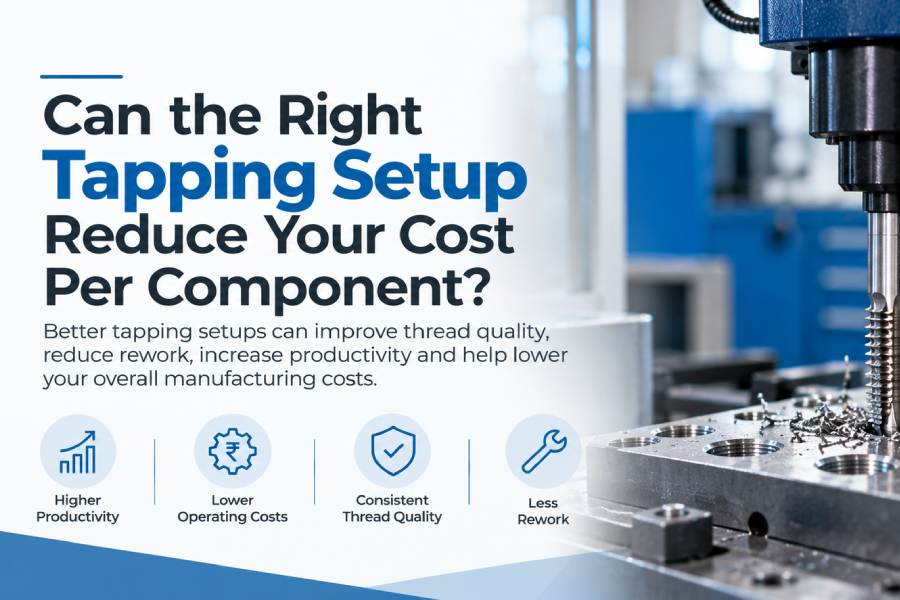
Introduction
Every manufacturer wants to produce more components without increasing production expenses. However, small inefficiencies during threading operations can quietly increase costs. For manufacturers evaluating equipment from Tapping Machine Manufacturers In India, selecting the right tapping setup can be an important step towards improving consistency, reducing rework, and controlling production costs.
A tapping machine does more than create internal threads. It influences machining time, tool life, operator workload, thread accuracy, and the number of usable components produced per shift. The good news is that reducing your cost per component does not always require a complete production line overhaul. Sometimes, choosing the right machine, improving tool selection, and optimizing the tapping process can deliver meaningful savings.
In this article, we will explore how an efficient tapping setup affects manufacturing costs, which factors matter most, and how to determine whether an equipment upgrade makes financial sense.
What Does Cost Per Component Really Mean?
Cost per component represents the total production cost divided by the number of acceptable components manufactured. For a tapping operation, the calculation should include more than the purchase price of the machine.
A practical formula is
Cost per acceptable component = Total tapping-related production costs ÷ Number of acceptable components produced
Consider these cost elements:
- Machine operating costs: Electricity, maintenance, and equipment depreciation.
- Labour costs: Operator time spent loading, positioning, tapping, and inspecting components.
- Tooling expenses: Taps, holders, replacement tools, and tool-related consumables.
- Quality costs: Inspection, rejected components, thread repairs, and rework.
- Downtime costs: Lost production caused by tool breakage, machine adjustments, and maintenance.
A machine with a lower purchase price may not necessarily produce the lowest cost per component. The better choice is the setup that consistently produces acceptable threads at a competitive total operating cost.
How the Right Tapping Setup Reduces Costs
1. Shorter Cycle Times Increase Output
Cycle time is the time required to complete an operation on one component. Even a small reduction can make a noticeable difference when thousands of parts are produced. An appropriately selected Industrial Tapping Machine can improve cycle time through controlled spindle movement, convenient positioning, and repeatable operating sequences.
For example, consider a workshop producing 5,000 components each month. If an improved setup saves six seconds per component, the total time saved is
- Monthly production: 5,000 components
- Time saved per component: 6 seconds
- Total time saved: 30,000 seconds
- Equivalent time saved: 8.33 hours per month
That recovered time can be used for additional production, other machining operations, or reduced overtime, depending on the workshop’s workflow.
Key takeaway: Small cycle-time improvements can create substantial capacity gains when production volumes are high.
2. Better Thread Quality Reduces Rejection Rates
A threaded hole that is too shallow, misaligned, or incorrectly formed can make an otherwise finished component unusable.
Common causes of thread defects include
- Incorrect spindle alignment.
- Unsuitable tap selection.
- Inconsistent feed and speed settings.
- Poor workpiece clamping.
- Worn or damaged cutting tools.
- Incorrect tapping depth.
A suitable machine setup helps operators maintain consistent positioning and control. This can improve Thread Tapping Efficiency while reducing avoidable rework and scrap. However, machine selection alone cannot guarantee thread quality. Correct tapping parameters, suitable cutting fluid where required, proper workholding, and routine tool inspection remain essential.
3. Longer Tool Life Lowers Consumable Costs
Taps are consumable tools, and their replacement costs can accumulate quickly in high-volume manufacturing. Incorrect cutting speeds, poor chip evacuation, unsuitable lubrication, and excessive tool loading can cause premature wear or breakage.
To improve tool life
- Select taps designed for the workpiece material.
- Use the manufacturer’s recommended cutting parameters.
- Choose an appropriate tapping method for blind or through holes.
- Ensure chips can escape without damaging the threads.
- Inspect tools regularly and replace them before failure affects production.
- Use suitable lubrication or coolant according to the material and application.
A well-matched tapping system helps reduce unnecessary tool changes and the production interruptions associated with broken taps.
4. Lower Operator Workload Improves Productivity
Manual positioning and repetitive handling can consume a significant portion of the production cycle. Depending on the application, flexible-arm tapping machines, electric tapping machines, and CNC-controlled systems can make positioning and operation more convenient.
Potential benefits include
- Less time spent manually aligning the tool.
- More consistent operation across repeated jobs.
- Reduced operator fatigue during repetitive tasks.
- Easier standardization of working procedures.
- More time available for inspection or other production activities.
These benefits contribute to Tapping Machine Productivity when the machine is selected according to the component geometry, production volume, and operator workflow. Automation does not eliminate the need for skilled operators. Setup, tool changes, quality checks, and preventive maintenance still require appropriate training.
5. Reduced Downtime Supports Manufacturing Cost Reduction
Unexpected downtime affects both output and delivery schedules. A tapping machine that frequently requires adjustment or repair can create production bottlenecks.
A practical approach to Manufacturing Cost Reduction includes
- Scheduling preventive maintenance.
- Checking spindle and holder condition.
- Maintaining correct alignment.
- Monitoring unusual noise, vibration, or heat.
- Keeping commonly used replacement tools available.
- Training operators to identify early signs of trouble.
Reliable equipment and consistent maintenance practices can help reduce interruptions and keep production schedules more predictable.
6. Flexible Setups Reduce Changeover Time
Manufacturers producing several component types need equipment that can accommodate different hole positions, sizes, and workpiece configurations. A flexible tapping setup can reduce the time required to reposition equipment or prepare for another job.
For example, a workshop producing small batches of aluminium brackets, steel fixtures, and machine parts may benefit from equipment that offers convenient arm movement, suitable tapping capacity, and straightforward adjustments.
Before selecting a machine, assess the range of components you manufacture rather than focusing on a single high-volume job.
Key Factors to Consider When Choosing a Tapping Setup
The right machine depends on your actual production requirements. Evaluate the following factors before investing.
| Selection factor | What to evaluate | Why it matters |
|---|---|---|
| Workpiece material | Aluminium, mild steel, stainless steel, or other materials | Affects tap selection, cutting parameters, and tool life |
| Thread specifications | Thread diameter, pitch, and depth | Determines machine capacity and tooling requirements |
| Production volume | Daily output and batch sizes | Helps establish the required cycle time |
| Hole configuration | Blind holes, through holes, and hole positions | Influences tapping method and chip evacuation |
| Positioning requirements | Number and location of holes per component | Determines the value of flexible positioning or CNC control |
| Available workspace | Bench space, floor area, and workpiece dimensions | Helps ensure practical installation and handling |
| Maintenance support | Service availability, spare parts, and training | Influences downtime and long-term operating costs |
Practical tip: Prepare a list of your most frequently produced components, including material, thread size, hole depth, and target output. This makes it easier to compare machines based on real requirements.
Manual vs. Electric vs. CNC Tapping
Different tapping technologies suit different production environments. No single option is ideal for every workshop.
| Tapping setup | Main advantages | Potential limitations | Suitable applications |
|---|---|---|---|
| Manual tapping | Low initial investment and simple operation | Greater dependence on operator technique and potentially longer cycle times | Occasional jobs and low production volumes |
| Electric tapping | Convenient operation and repeatable tapping sequences | Requires suitable power, tooling, and capacity selection | General workshop production and repetitive threading |
| CNC tapping | Programmable control and integration with machining operations | Higher investment and programming requirements | Complex components and suitable high-volume production |
| Flexible-arm tapping | Convenient positioning across multiple holes within its working range | Reach, mounting, and capacity must match the workpiece | Components with several tapping locations |
When evaluating Cost-Effective Tapping Solutions, consider both equipment cost and expected performance over its working life.
For example, a flexible-arm machine may suit a workshop that taps several holes across large components. A CNC solution may be more appropriate when threading is part of a larger automated machining process.
The most economical option is the one that meets the required quality and production targets without unnecessary complexity.
Pros and Cons of Upgrading Your Tapping Setup
An equipment upgrade can improve production economics, but it should be supported by a clear assessment.
Advantages
- Higher production capacity: Shorter cycle times can increase available output.
- More consistent quality: Repeatable positioning can reduce avoidable thread defects.
- Potentially lower tooling costs: Appropriate operating conditions can improve tap life.
- Reduced manual effort: Easier operation can improve workflow and reduce fatigue.
- Better process control: Standardized settings make production easier to monitor.
Limitations
- Initial investment: New equipment requires capital and installation planning.
- Training requirements: Operators may need instruction on setup, programming, and maintenance.
- Compatibility concerns: Existing fixtures, workpieces, and tooling may require adjustments.
- Maintenance obligations: Every machine needs suitable servicing and inspection.
- Uncertain savings: Actual returns depend on production volume, utilization, quality, and operating costs.
An upgrade is most valuable when it addresses a measurable production problem rather than adding features that the workshop rarely uses.
Conclusion
The right tapping setup can help manufacturers control production expenses without compromising thread quality. Improvements in cycle time, tool life, operator efficiency, and process consistency can all contribute to a lower cost per acceptable component. However, the best results come from matching the equipment to the actual application. Consider your workpiece materials, thread specifications, production targets, and maintenance requirements before deciding whether to upgrade.
Start by measuring your current cost per component, identifying the biggest sources of waste, and comparing suitable equipment against those specific problems. Even a modest improvement can make a meaningful difference when repeated across thousands of components.
FAQ’s
Find a smarter way to improve threading accuracy and control production costs.