
Table of Contents
ToggleIntroduction
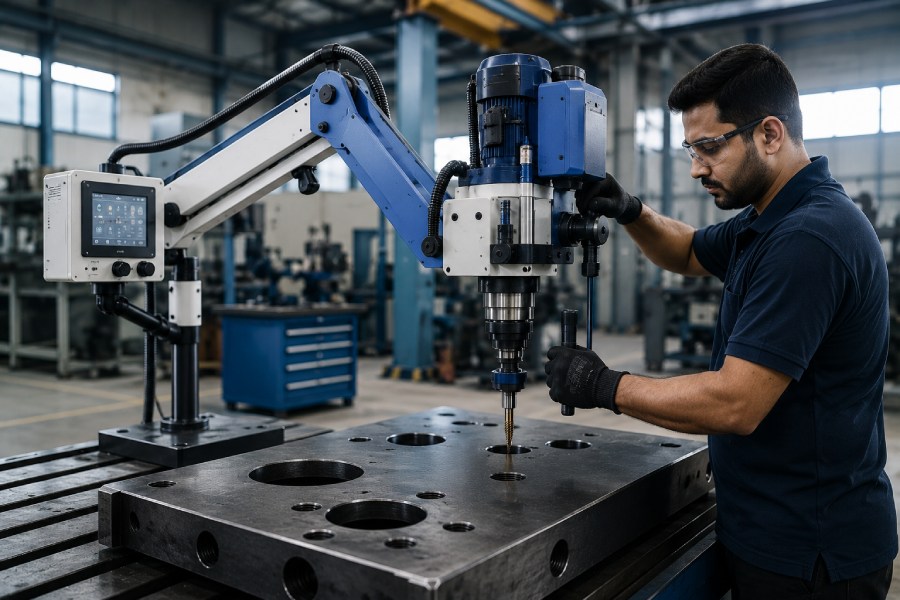
A threading machine can be highly accurate, but accuracy becomes less useful when the equipment cannot easily reach the workpiece. A Portable Tapping Machine addresses this challenge by giving operators greater freedom to position the equipment where the threading job actually needs to be performed.
Modern manufacturing is no longer limited to perfectly arranged production lines. Workshops handle large components, awkward assemblies, different batch sizes, and jobs that may require access from multiple directions. This is where mobility becomes more than a convenience. It becomes a practical factor in equipment selection.
- Why mobility affects threading productivity
- How movement can improve workpiece accessibility
- Which features matter when selecting equipment
- Where mobile solutions offer the greatest value
- The advantages and limitations to consider before investing
What Does Mobility Mean in Threading Equipment?
Mobility refers to how easily threading equipment can be positioned, adjusted, or moved according to the requirements of a job. It does not simply mean that a machine can be carried from one location to another.
Good mobility can involve:
- A flexible working arm
- Adjustable positioning
- Extended working reach
- Easy access to different areas of a workpiece
- Compact equipment design
- Convenient operator controls
- Compatibility with different workshop layouts
In practical terms, mobile tapping equipment allows the machine to adapt to the workpiece instead of forcing the workpiece to adapt to the machine. That difference can become significant when manufacturing teams work with large, heavy, or irregularly shaped components.
Why Mobility Matters on the Shop Floor
1. Large Workpieces Are Not Always Easy to Move
Moving a small component to a fixed machine may be straightforward. Moving a large fabricated structure, heavy casting, frame, or assembled component is a different story. When the workpiece is difficult to reposition, bringing the threading equipment closer to the required hole can be more practical.
This can reduce unnecessary:
- Material handling
- Crane or lifting operations
- Workpiece repositioning
- Setup time
- Operator effort
The result is a smoother workflow, particularly for workshops handling different component sizes.
2. Better Access to Difficult Areas
Some threading jobs are located in areas that are difficult to reach with conventional fixed equipment.
For example, a workpiece may contain:
- Deep sections
- Multiple faces
- Narrow access points
- Large structural surfaces
- Offset holes
- Different hole orientations
Mobile equipment can provide additional positioning freedom. This is especially useful when the operator needs to approach the hole from a particular direction while maintaining proper alignment.
3. Less Unnecessary Movement
Every time a large workpiece needs to be moved, there is an additional handling requirement. A more mobile threading setup can help keep the workpiece in place while the equipment is positioned around it.
Move the tool when possible, rather than repeatedly moving the workpiece.
That principle can be valuable in fabrication and general industrial production.
Key Benefits of Mobile Threading Equipment
Improved Productivity
Productivity is not only about how quickly a machine cuts a thread. It also depends on everything happening before and after the actual threading operation.
Mobile threading equipment can help reduce time spent on
- Positioning
- Setup
- Workpiece movement
- Repeated alignment
- Accessing different holes
When these small time savings occur across many components, the overall impact can become meaningful.
Productivity gains may come from:
- Faster positioning
- Easier access
- Reduced setup interruptions
- Smoother movement between holes
- Better workflow continuity
Greater Workshop Flexibility
Manufacturing environments change frequently. One day, a workshop may be producing small components. The next, it may be working with large assemblies or custom-fabricated parts. Industrial threading machines with greater movement flexibility can adapt more easily to these changing requirements.
This makes them useful for workshops where:
- Production volumes vary
- Component dimensions differ
- Custom jobs are common
- Multiple threading locations are required
- Floor space is limited
Flexibility can therefore become an important part of long-term equipment value.
Better Operator Ergonomics
Operators often spend considerable time positioning tools and aligning them with drilled holes. Poor positioning can make the job uncomfortable and unnecessarily demanding. Equipment with an appropriately designed arm and control system can make positioning more manageable.
Good ergonomics can help operators:
- Maintain a more comfortable working position
- Position the tool with less physical effort
- Reach different areas more easily
- Reduce unnecessary movement
- Work more consistently during repetitive operations
Ergonomics should not be treated as an optional feature. It can directly influence daily usability.
Mobility vs Fixed Threading Systems
Both mobile and fixed threading systems have their place.
The right choice depends on the application.
| Factor | Mobile Equipment | Fixed Equipment |
|---|---|---|
| Workpiece flexibility | High | Moderate to low |
| Access to large components | Strong | Limited by machine setup |
| Positioning freedom | High | More restricted |
| Repetitive production | Suitable depending on application | Excellent |
| Floor layout flexibility | High | Lower |
| Setup adaptability | Strong | More structured |
| Large workpiece handling | Often advantageous | May require repositioning |
| Dedicated production cells | Less necessary | Highly suitable |
A fixed system can be an excellent choice for repetitive, high-volume production where components are standardized.
A mobile solution becomes more attractive when accessibility, component size, and changing production requirements are major considerations.
Features to Look for Before Buying
Choosing threading equipment based only on price can create problems later. Instead, evaluate the complete operating environment.
1. Working Reach
Check how far the equipment can reach from its mounting or operating position. A greater working radius can make it easier to access holes positioned across larger components.
Ask:
- What is the required reach?
- Are holes located on multiple surfaces?
- Will longer reach affect stability?
- Does the equipment offer different arm configurations?
2. Tapping Capacity
The machine should match the thread sizes commonly required in your workshop.
Consider:
- Minimum thread size
- Maximum thread size
- Material being tapped
- Daily workload
- Required torque
Buying equipment with insufficient capacity can restrict future applications.
At the same time, selecting a much larger machine than necessary can increase investment without delivering practical benefits.
3. Speed and Torque Control
Different materials and thread sizes may require different operating conditions. Adjustable speed and torque can provide greater control over the tapping process. This can be particularly useful when a workshop handles multiple materials or thread specifications.
Look for:
- Controlled rotation
- Appropriate torque adjustment
- Forward and reverse operation
- Stable performance
- Easy parameter selection
4. Positioning and Alignment
Mobility is valuable only when movement can be translated into accurate positioning. The equipment should allow the operator to bring the tapping head into proper alignment with the hole.
Poor alignment can contribute to:
- Thread quality problems
- Tool wear
- Tap breakage
- Inconsistent results
- Rework
Therefore, mobility and precision should be considered together.
5. Ease of Operation
Operators should not need to fight the machine to complete a basic threading task. A practical threading system should offer intuitive controls and straightforward adjustments.
Useful features may include:
- Easy-to-use controls
- Clear settings
- Convenient handle positioning
- Depth control
- Simple tool changes
- Accessible operating controls
The simpler the normal operating process, the easier it is to maintain consistent production.
Where Mobile Threading Equipment Works Best
Mobile solutions can be particularly useful in applications where the workpiece is difficult to transport or reposition.
Fabrication Workshops
Fabricators frequently handle frames, structures, plates, and custom assemblies. Mobility can make threading different areas of these components easier.
Heavy Engineering
Large components may be impractical to repeatedly move between workstations. A mobile threading setup can provide greater access while the component remains positioned for production.
Maintenance Operations
Maintenance work often happens around existing equipment rather than in a controlled production cell. Equipment that can reach different working locations can provide practical advantages.
Automotive and Component Manufacturing
Manufacturers dealing with varied components may benefit from equipment that offers positioning flexibility without sacrificing repeatability.
General Engineering Workshops
For workshops handling different job sizes and specifications, versatility can be a major advantage.
Mobility Should Not Mean Sacrificing Precision
One common misconception is that greater movement automatically means less accuracy. That is not necessarily true. The real question is how the equipment manages movement.
A well-designed system should combine:
- Controlled movement
- Stable arm construction
- Proper tool alignment
- Suitable torque
- Controlled speed
- Appropriate depth management
The objective is simple:
The operator should have freedom to position the machine without losing control over the threading operation.
That is where a Flexible tapping machine can become particularly useful for applications requiring access from different angles.
Pros and Cons of Mobile Threading Equipment
Pros
- Easier access to large workpieces
- Greater positioning flexibility
- Reduced workpiece movement
- Useful for varied production requirements
- Better suitability for difficult-to-reach holes
- Can improve workflow efficiency
- Useful where floor layout changes frequently
- Can support multiple applications
Cons
- May require more attention to positioning
- Not always the best choice for dedicated mass production
- Working range must match the application
- Incorrect setup can affect alignment
- Initial investment should be evaluated against actual usage
The goal is to choose equipment that provides the right amount of mobility for the work your workshop actually performs.
How to Choose the Right Solution
Before making a purchase, create a simple application checklist.
Step 1: Study Your Workpieces
Record:
- Typical dimensions
- Weight
- Material
- Thread sizes
- Hole locations
- Hole orientations
Step 2: Identify Movement Problems
Ask your operators where they lose the most time.
- Moving components?
- Repositioning fixtures?
- Reaching difficult areas?
- Aligning the tool?
- Changing settings?
These answers can reveal whether mobility will provide real value.
Step 3: Calculate Your Required Reach
Do not choose arm length based on assumptions. Measure the actual distance between the equipment mounting area and the most difficult tapping location.
Step 4: Match Capacity With Production Needs
Consider both current and expected future requirements. A suitable machine should handle your normal thread range without unnecessary oversizing.
Step 5: Evaluate Operator Experience
The best equipment on paper may not be the best equipment in daily use.
Ask operators to evaluate:
- Handle comfort
- Movement
- Controls
- Visibility
- Setup
- Tool changing
Their practical feedback can reveal issues that specifications alone cannot show.
A Simple Mobility Checklist
Before selecting threading equipment, ask these questions:
- Can the machine reach every required tapping location?
- Can large components remain in position?
- Is the arm movement smooth and controlled?
- Is alignment easy to achieve?
- Does the equipment support the required thread range?
- Can speed and torque be adjusted?
- Is the operating interface simple?
- Will it fit the existing workshop layout?
- Can it support future production requirements?
- Will operators be comfortable using it throughout the day?
If the answer to most of these questions is yes, the equipment is more likely to fit the real needs of the workshop.
Conclusion
Mobility has become an important consideration when selecting modern threading equipment because real-world manufacturing rarely happens under perfectly fixed conditions. Large components, changing production requirements, limited floor space, difficult access points, and varied workpieces can all make equipment flexibility valuable.
The right solution should provide more than movement. It should combine accessibility, control, precision, suitable capacity, operator comfort, and reliable performance. When mobility solves a genuine production challenge, it can become a practical way to make threading operations more efficient and adaptable.
Mobile tapping equipment provides greater positioning flexibility and can make it easier to reach holes on large, irregular, or difficult-to-move workpieces. This can reduce unnecessary handling and improve workflow efficiency.
A Flexible tapping machine can be useful when threading operations involve different hole positions, angles, or workpiece sizes. Its movement capability can provide greater access than a rigid setup.
Make every threading operation easier to reach and control.