
Table of Contents
ToggleIntroduction
Threading may look like a small operation compared with cutting, forming, welding, or machining, but a poorly tapped hole can create problems much further down the production line. Manufacturers looking for dependable threading performance can explore solutions from Automatic Tapping Machine Manufacturers in India. From inconsistent thread depth to operator fatigue and unpredictable cycle times, manual or poorly controlled tapping processes can quietly affect productivity, quality, and delivery schedules. In this article, we will look at five common production problems and explain how an automatic tapping system can help solve them.
Modern manufacturing is increasingly focused on repeatability. Customers expect components to meet specifications consistently, while production teams need to achieve higher output without allowing quality to slip. Tapping is therefore no longer simply about creating an internal thread. It is about creating that thread accurately, repeatedly, and at a predictable production rate.
Why Thread Tapping Matters in Modern Production
Tapping creates internal threads that allow components to be assembled with bolts, screws, studs, and other threaded fasteners. The process is used across industries such as automotive components, engineering, electrical equipment, machinery manufacturing, fabrication, appliances, and general industrial production.
A tapping operation can involve several variables, including
- Hole diameter
- Material type
- Thread size
- Thread depth
- Spindle speed
- Feed rate
- Tool condition
- Lubrication
- Workpiece positioning
- Operator technique
When these variables are not controlled properly, production quality can vary from one component to another.
For a low-volume workshop, a small variation may be manageable. In a high-volume environment, however, even a minor recurring problem can result in hundreds or thousands of affected components.
What Is an Automatic Tapping System?
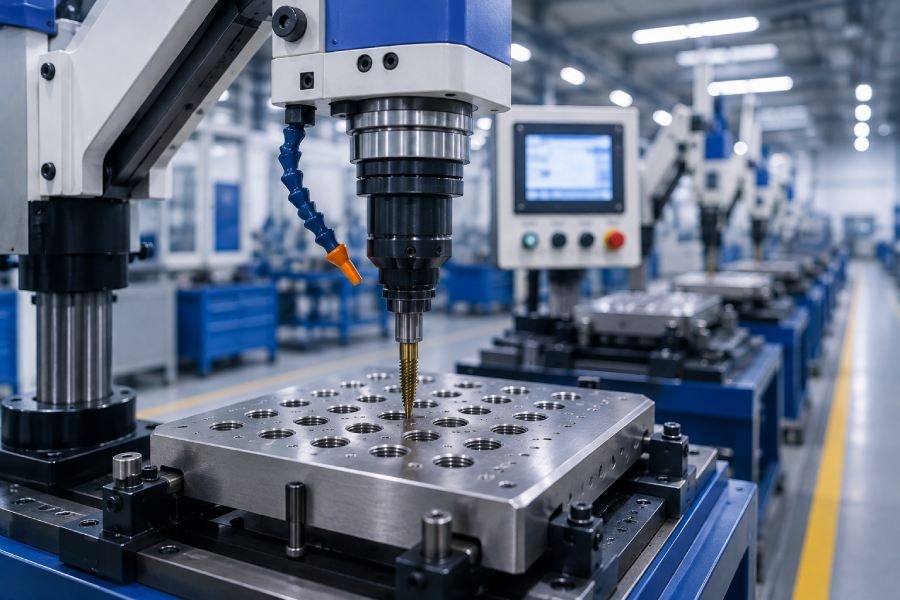
An automatic tapping system is designed to perform thread tapping with controlled machine movement, speed, feed, depth, and other operating parameters. Depending on the machine configuration, the system can reduce the amount of manual intervention required during repetitive tapping operations.
An automated tapping machine can be particularly useful when the same component requires identical threaded holes across a large production batch.
The important point is that automation should not simply mean adding machinery. It should solve a genuine production challenge.
Problem 1: Inconsistent Thread Quality
One of the most common problems in manual tapping is variation between components. An operator may produce a good thread on one workpiece and a slightly different result on another. Factors such as hand pressure, alignment, speed, feed control, and concentration can influence the result.
This becomes especially challenging when a production line handles hundreds of similar components.
How automation helps
An automatic thread tapping machine can maintain more consistent operating conditions throughout a production batch. Once appropriate parameters are established, the machine can repeat the tapping cycle with significantly less dependence on manual movement.
This can help control:
- Tapping depth
- Feed movement
- Spindle rotation
- Thread alignment
- Cycle sequence
- Tool engagement
Consistency is particularly important when threaded holes need to match mating components precisely.
For example, imagine a manufacturer producing metal housings with four threaded holes in every unit. If one hole is slightly deeper, misaligned, or damaged, the assembly team may experience difficulty during fastening. Repeating that problem across a batch can quickly turn into a quality issue.
Why consistency matters beyond the tapping station
Thread quality does not exist in isolation.
A correctly tapped hole can make assembly easier, reduce fastening problems, and support predictable component performance. In contrast, inconsistent threads can lead to rejected parts, additional inspection, rework, or customer complaints.
That makes process consistency a production concern rather than simply a machining concern.
Problem 2: Slow and Uneven Production Cycles
Production efficiency is not determined only by how quickly a machine operates. It also depends on how consistently each cycle can be completed. Manual tapping may require an operator to repeatedly position the component, start the operation, control the tool, check the result, and prepare the next piece.
How an industrial tapping machine improves cycle control
An industrial tapping machine can establish a repeatable operating sequence. Once the workpiece is correctly positioned and the machine is configured, the tapping cycle can be performed in a more predictable manner.
Suppose one operator completes a tapping operation in 20 seconds while another takes 28 seconds because of differences in handling speed. Over a small batch, the difference may not seem significant.
Production planning becomes easier
Predictable cycles also make production planning more practical.
When manufacturers have a clearer understanding of how long a tapping operation should take, they can estimate
- Batch completion times
- Labour requirements
- Machine utilization
- Shift output
- Production capacity
- Delivery schedules
The goal is not simply to make the machine run faster. The goal is to create a reliable production rhythm.
Problem 3: Operator Fatigue and Repetitive Work
Repetitive tapping operations can place physical and mental demands on operators, particularly when components are handled continuously throughout a shift.
Repeated positioning, tool movement, checking, and manual control can become tiring over time. Fatigue matters because it can affect concentration and consistency.
Automation can reduce repetitive workload
A tapping machine for production can take over much of the repetitive movement involved in the tapping cycle.
The operator can then spend more time on tasks such as:
- Loading and unloading components
- Checking finished parts
- Monitoring tool condition
- Managing material flow
- Performing quality checks
- Responding to machine alerts
This changes the operator’s role from continuously performing the same mechanical action to supervising and managing the process.
Better ergonomics can support better productivity
Reducing repetitive physical work does not automatically eliminate every workplace risk, but it can help create a more manageable workflow. Good machine design, appropriate workpiece handling, correct workstation height, and suitable tooling should all be considered together.
Automation works best when it is part of a broader effort to make production safer, more comfortable, and more efficient.
Problem 4: High Rejection and Rework Rates
Rework is one of those costs that can be easy to underestimate. A component may appear inexpensive to produce, but once it requires additional inspection, correction, retapping, replacement, or handling, the actual cost increases.
Thread-related defects can contribute to this problem.
Common issues may include
- Incorrect thread depth
- Damaged threads
- Misalignment
- Incomplete threads
- Poor thread formation
- Incorrect tapping parameters
- Tool-related defects
How an automatic tapping system can help
Automation improves process repeatability. When the tapping parameters are properly established for a particular component and material, the machine can reproduce the operation more consistently.
Tool wear, incorrect setup, poor lubrication, unsuitable tapping speeds, material inconsistencies, and improper workholding can still create problems. That is why process control remains important even when the machine is automated.
The importance of preventive maintenance
A reliable tapping operation depends on more than machine movement.
Operators and maintenance teams should monitor
- Tool condition
- Lubrication
- Machine alignment
- Workholding
- Thread quality
- Unusual vibration
- Changes in cycle performance
A small change in machine behaviour can sometimes indicate tool wear or another developing issue.
Problem 5: Difficulty Maintaining Production Consistency
One of the biggest challenges in manufacturing is maintaining the same output and quality across different shifts, operators, and production batches. A process that depends heavily on individual operator technique may produce different results from one shift to another.
This does not necessarily mean the operators lack skill. Human variation is simply part of manual processes.
Standardized processes create predictable results
An automatic tapping system can help standardize the tapping operation by establishing defined machine parameters.
Depending on the machine and application, these may include
- Spindle speed
- Feed rate
- Tapping depth
- Cycle sequence
- Tool movement
- Workpiece positioning
Once the correct setup has been validated, the same process can be repeated across production batches.
This can make quality management easier because the manufacturer has greater control over how the operation is performed.
Supporting scalable production
Consistency becomes even more important when production volumes increase. A process that works for 100 components may become difficult to manage manually when the requirement grows to several thousand components.
Automation can help manufacturers increase capacity without relying on a proportional increase in repetitive manual effort. That makes automated tapping particularly relevant for companies looking to expand production while maintaining consistent standards.
Additional Benefits of Automated Tapping
The five problems above are the most obvious reasons to consider automation, but there can be several additional advantages.
-
Better process repeatability
Once machine parameters are established correctly, the same tapping sequence can be repeated across a batch.
-
More predictable production planning
Consistent cycles can make it easier to estimate output and schedule work.
-
Improved operator utilization
Operators can focus on supervision, inspection, loading, unloading, and other productive tasks.
-
Reduced dependence on manual technique
The machine takes responsibility for much of the repetitive tapping motion.
-
Better production monitoring
Automated processes can make it easier to identify changes in cycle behaviour and investigate quality issues.
-
Greater suitability for repetitive applications
Where the same tapping operation is performed repeatedly, automation can provide considerable value.
Pros and Cons of Automatic Tapping
Automation offers clear advantages, but it should be selected based on the actual production requirement.
| Advantages | Considerations |
|---|---|
| More consistent tapping cycles | Higher initial investment than basic manual tools |
| Reduced repetitive operator work | Requires proper machine setup |
| Improved production repeatability | Operators may require training |
| Potentially lower rework | Tool wear still needs monitoring |
| Better production planning | Machine selection must match the application |
| Suitable for repetitive production | CNot every low-volume job requires automation |
The key is to evaluate the complete production process rather than judging a machine only by its purchase price.
A system that reduces rejected components, improves output, and saves operator time may provide greater long-term value than a lower-cost option that continues to depend heavily on manual intervention.
How to Choose the Right System for Your Production
Choosing an automated tapping solution should begin with the application.
Before making a decision, manufacturers should consider the following factors.
1. Material being tapped
Aluminium, mild steel, stainless steel, cast iron, and other materials can behave differently during tapping. Machine capability and tooling should suit the material.
2. Thread sizes
The required thread range should be checked carefully. A machine designed for the required tapping range can provide more practical flexibility.
3. Production volume
High-volume repetitive production generally provides a stronger case for automation than occasional tapping work.
4. Component design
The shape, size, weight, and accessibility of the workpiece can influence machine selection and workholding requirements.
5. Required tapping depth
Different applications may require different tapping depths and levels of control.
6. Available workspace
Machine dimensions and installation requirements should be considered before final selection.
7. Operator requirements
Look for a system that provides practical controls and can be operated efficiently after suitable training.
8. Maintenance and service
Long-term performance depends on maintenance, tooling, spare parts, and technical support. These factors should be considered alongside machine specifications.
Conclusion
Thread tapping may be only one stage of a manufacturing process, but its impact can extend across quality, assembly, productivity, labour utilization, and delivery performance.
For companies handling repetitive threading operations, now is a good time to examine where manual variation is affecting production and whether a more controlled approach could make a measurable difference.
FAQ’s
An automatic tapping system is used to create internal threads in pre-drilled holes with controlled machine movement. It is particularly useful for repetitive production where consistent thread quality, predictable cycles, and reduced manual intervention are important.
Make every threading cycle more consistent and production-ready.