
Table of Contents
ToggleIntroduction
Ordering a new machine is not simply a matter of comparing prices. When evaluating Tapping Machine Suppliers, manufacturers need to consider thread sizes, material compatibility, production volume, accuracy, operator requirements, machine reach, safety, maintenance, and long-term operating costs. A machine that looks suitable on paper may still become a poor investment if it does not match the actual demands of your shop floor.
This guide covers seven practical questions that manufacturing managers, production engineers, workshop owners, and procurement teams should ask before buying an industrial tapping machine.
Why Asking the Right Questions Matters
Thread tapping is a precision operation. The machine needs to rotate the tap correctly, maintain alignment, control depth where required, and provide suitable torque for the material and thread size.
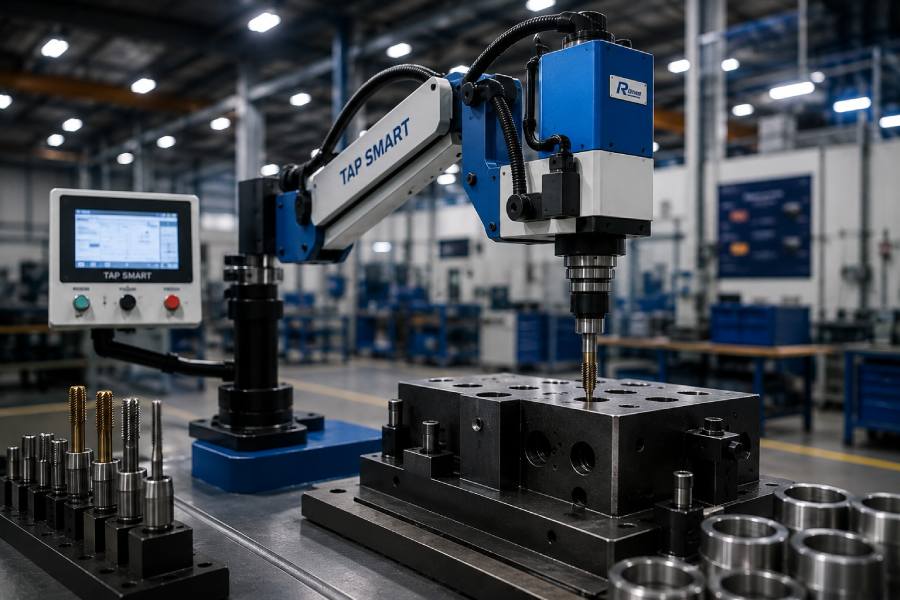
Ravisons, for example, offers Tap Smart models across different tapping capacities, with options covering applications from M3 through M36. Its product range also includes different arm lengths and head configurations for different working requirements.
The goal, therefore, is not to buy the most advanced machine available. It is to buy the machine that solves your specific production problem.
Q1: What Thread Sizes and Materials Will the Machine Handle?
This should be one of the first questions asked during the buying process.
Different manufacturing environments work with different thread sizes, materials, hole depths, and component geometries. A machine suitable for smaller aluminum components may not be appropriate for large steel fabrications.
Start by documenting
- Minimum and maximum tap sizes
- Common thread standards
- Required tapping depths
- Workpiece materials
- Hole diameter and depth
- Blind or through-hole applications
- Average and maximum daily tapping volume
For example, Ravisons’ Tap Smart range currently lists models from M3 to M36, with different speed and power specifications depending on the model.
Why Material Compatibility Matters
Material hardness directly affects tapping conditions. Aluminum, mild steel, stainless steel, cast iron, and other engineering materials can require different cutting conditions, lubrication practices, tap geometries, and torque levels.
A suitable Thread tapping machine should therefore be selected around your actual materials rather than a generic catalogue specification.
That gives the supplier enough information to recommend equipment based on the real application rather than assumptions.
Q2: What Level of Accuracy and Repeatability Do We Need?
Accuracy becomes especially important when components are produced in batches or when threaded holes need to meet strict assembly requirements.
A Precision tapping machine should provide controlled movement and consistent thread formation from one component to the next. But accuracy is not determined by one specification alone.
Look at factors such as
- Hole alignment
- Tap perpendicularity
- Depth control
- Torque control
- Spindle stability
- Tap holding system
- Repeatability between cycles
- Operator positioning
For applications where the operator needs to move between multiple holes, machine flexibility can also make a significant difference. Ravisons’ Tap Smart system uses a flexible arm designed to assist with hole positioning and perpendicular tapping, while its control panel allows settings such as tap size, pitch, depth, and speed to be selected.
Ask for Evidence, Not Just Claims
Instead of asking only, “Is the machine accurate?”, ask how accuracy is achieved.
Request information about the machine’s control system, tap holding arrangement, depth control, torque management, and practical application results.
A good supplier should be able to explain these factors clearly.
Q3: How Fast Does the Machine Need to Work?
Speed sounds simple, but faster is not always better.
A High-speed tapping machine must still maintain appropriate torque, alignment, thread quality, and control. Increasing spindle speed without considering the material, tap size, lubrication, and application can create quality or tool-life problems.
Instead of focusing only on maximum RPM, calculate the actual production requirement.
Ask
- How many threaded holes are produced per shift?
- What is the average cycle time?
- How much time is spent positioning components?
- How often are taps changed?
- What percentage of production involves rework?
- Is the bottleneck actually tapping?
A machine with better positioning and easier operation can sometimes improve overall output more than a machine with a higher maximum spindle speed.
For instance, Ravisons lists different operating speeds across its Tap Smart models. Smaller-capacity models can operate at higher speeds, while larger tapping capacities use lower speeds appropriate to the application.
Think About Total Cycle Time
The useful metric is not simply RPM. Consider the complete process:
Positioning + tapping + reversing + unloading + inspection = total cycle time
A machine that reduces operator movement and simplifies settings can deliver meaningful productivity gains even when its headline RPM is not the highest available.
Q4: Will the Machine Fit Our Shop Floor and Workpieces?
A machine can have excellent specifications and still be unsuitable if operators cannot comfortably reach the required holes.
This is particularly important when dealing with large, irregular, heavy, or frequently changing workpieces.
Before ordering, measure
- Workpiece dimensions
- Workpiece weight
- Hole locations
- Required tapping radius
- Available floor space
- Machine mounting area
- Operator working position
- Access around the component
Flexible-arm systems can be useful when several holes need to be reached from different positions. Ravisons offers flexible-arm configurations and lists working-radius options for its Tap Smart models.
Consider the Operator’s Actual Movement
Imagine an operator tapping 200 holes per shift. If every hole requires awkward repositioning, the machine may still create unnecessary fatigue and lost time. Ask for a demonstration using a component that resembles your actual production work. A live demonstration can reveal practical limitations that a specification sheet cannot.
Q5: What Safety and Tap Protection Features Are Included?
Tap breakage is more than a tooling expense. A broken tap can damage a component, interrupt production, create rework, and potentially expose operators to avoidable risks. This makes tap protection an important part of the buying decision.
Ask whether the machine includes:
- Torque adjustment
- Safety tap collets
- Controlled forward and reverse movement
- Depth control
- Emergency stop functions
- Suitable guarding
- Operator-friendly controls
Ravisons’ Tap Smart machines use safety tap collets with torque settings intended to help prevent tap breakage. The machines also include forward and reverse controls and a control panel for adjusting operating parameters.
Safety Should Be Part of the Specification
Do not treat safety as an optional discussion after the machine has been selected. Ask the supplier how operators are expected to load components, position the arm, change taps, set torque, and respond to a jam or abnormal condition.
The best equipment is not only productive. It should also be straightforward and predictable for the people using it every day.
Q6: What Maintenance, Training, and After-Sales Support Are Available?
Buying the machine is only the beginning.
Industrial equipment needs proper installation, operator training, routine inspection, replacement parts, and technical support. Even a reliable machine can underperform if operators do not understand its controls or maintenance requirements.
Before ordering, ask
- Is installation support provided?
- Is operator training included?
- What routine maintenance is required?
- Which parts are considered consumables?
- How quickly are replacement components available?
- Who provides technical assistance?
- Is troubleshooting support available?
- What warranty is included?
Ravisons states that it has been developing tapping machines since 2003 and has installed more than 3,000 machines nationwide. Its product portfolio includes Tap Smart and Spiro solutions for different tapping requirements.
That kind of company history can be useful when evaluating whether a supplier has experience supporting industrial users over the long term.
Q7: What Is the Real Cost of Ownership?
The purchase price is only one part of the financial equation. A lower-priced machine may become expensive if it requires frequent maintenance, consumes more power, produces excessive rejects, or slows down production.
Calculate the total cost of ownership by considering
- Purchase price
- Installation
- Tooling
- Tap consumption
- Electricity
- Lubrication
- Preventive maintenance
- Replacement components
- Operator time
- Downtime
- Rework
- Expected service life
Look Beyond the Initial Quote
Suppose one machine costs less but takes considerably longer to complete the same batch. Over several years, the productivity difference may outweigh the initial saving. Likewise, a machine that improves thread consistency can potentially reduce scrap and rework.
Important Specifications to Compare
Once you have answers to the seven questions, compare machines using the same criteria.
| Specification | Why It Matters |
|---|---|
| Tapping capacity | Determines suitable thread-size range |
| Speed | Influences cycle time and application suitability |
| Motor power | Indicates available operating capability |
| Torque control | Helps match tapping force to the application |
| Arm reach | Determines access to different hole positions |
| Depth control | Helps maintain consistent tapping depth |
| Tap holding system | Influences tool security and protection |
| Control interface | Affects setup and operator usability |
| Power requirement | Important for installation planning |
| Maintenance needs | Influences long-term operating cost |
| Training and support | Helps maintain consistent operation |
Ravisons currently lists Tap Smart models with capacities from M3 to M36, depending on the model, along with different speeds, power ratings, working radii, and tap-collet combinations.
A Practical Pre-Order Checklist
Before approving your purchase order, confirm the following:
- Required minimum and maximum tap sizes are documented.
- All major workpiece materials have been identified.
- Required tapping depths are known.
- Daily and monthly tapping volumes have been estimated.
- Required working radius has been measured.
- Available floor space has been checked.
- Machine speed is suitable for the application.
- Torque requirements have been discussed.
- Tap protection features have been reviewed.
- Operator training has been confirmed.
- Installation requirements are understood.
- Warranty terms have been reviewed.
- Spare parts availability has been discussed.
- Total ownership cost has been estimated.
- A machine demonstration or application test has been considered.
If these points are clear, your final purchasing decision is likely to be much more informed.
Conclusion
Choosing an industrial tapping machine should never be based on price or maximum speed alone. The better approach is to start with your production requirements and work backward.
A well-matched machine can become an important part of a more consistent, efficient, and operator-friendly production process. Ravisons offers tapping solutions across multiple capacities and configurations, making it worth comparing the available specifications against your actual manufacturing requirements.
FAQ’s
A tapping machine for industrial use creates internal threads in pre-drilled holes with controlled movement and rotation. Depending on its design, it can support different thread sizes, materials, production volumes, and workpiece configurations.
An Industrial thread tapping machine can improve production by providing controlled speed, consistent positioning, repeatable operation, and reduced manual effort. The right machine can also help reduce cycle-time variation and operator fatigue.
No. A High-speed tapping machine should be selected according to the material, tap size, thread type, lubrication method, and required thread quality. Maximum spindle speed alone should not determine the purchase decision.
Make your next tapping investment with greater confidence and better production control.