
Table of Contents
ToggleIntroduction
Manufacturing is a game of margins. Every second saved on the production floor, every defective part avoided, and every tool that performs consistently under pressure adds up to a measurable advantage over the competition. Threading, one of the most fundamental operations in metal fabrication and mechanical assembly, has historically been a bottleneck in many facilities. That is, until powered threading solutions entered the picture. Whether you are running a high-volume automotive plant or a precision engineering workshop, upgrading to an electric tapping machine can be a turning point for your production efficiency. In this article, you will learn exactly how powered threading works, what makes it superior to manual methods, which industries benefit most, and what to look for when choosing the right system for your operation.
What Is Powered Threading and Why Does It Matter?
Powered threading refers to the use of motor-driven equipment to cut, form, or chase internal and external threads in a workpiece. Unlike manual threading, which depends on the physical force and skill of an operator, powered threading automates the torque application, depth control, and reversal cycle that are required to produce a clean, accurate thread.
The significance of this shift cannot be overstated. Threads are everywhere in manufactured goods, from the smallest electronic enclosures to heavy-duty structural assemblies. A single poorly cut thread can compromise the integrity of an entire assembly, lead to product recalls, or create safety hazards. At scale, even a one percent defect rate in threading can represent thousands of rejected parts per month.
Powered threading addresses these concerns directly by standardizing the threading process, removing variability introduced by operator fatigue or inconsistency, and dramatically reducing the time it takes to complete each cycle.
The Core Mechanics Behind Powered Threading Systems
To appreciate why powered threading improves efficiency, it helps to understand what happens during a threading operation at a mechanical level.
When a tap or die engages a workpiece, it needs to apply precisely calibrated torque to cut the thread profile without breaking the tool or damaging the material. In manual operations, this torque comes from human muscle, which fluctuates with fatigue, hand positioning, and operator experience.
A powered threading system uses an electric motor to deliver consistent torque throughout the cutting cycle. Most modern systems include:
Torque Limiting Mechanisms: These protect both the tool and the workpiece by cutting off power if resistance exceeds a preset threshold, which prevents tap breakage.
Automatic Reversal: Once the tap reaches the programmed depth, the motor reverses automatically, extracting the tap cleanly and leaving a finished thread.
Variable Speed Control: Operators can adjust spindle speed to match the material being threaded, whether it is aluminum, stainless steel, cast iron, or composite materials.
Depth Stop Settings: Repeatable depth control ensures that every threaded hole in a batch is produced to the same specification.
Together, these features create a threading process that is faster, more accurate, and significantly less dependent on individual operator skill.
Key Ways Powered Threading Improves Manufacturing Efficiency
4.1 Faster Cycle Times and Higher Output
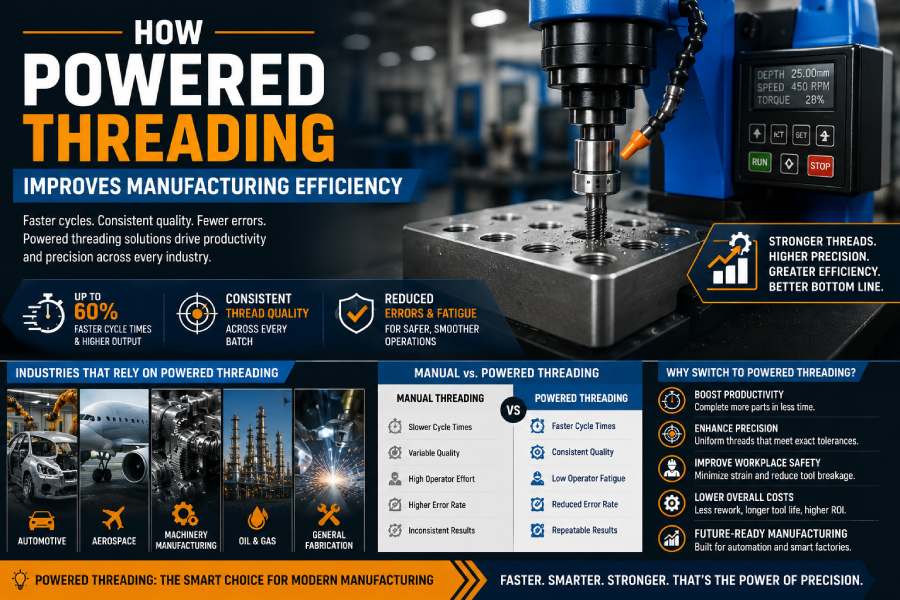
Speed is one of the most immediate and measurable benefits of switching to powered threading. A skilled operator using a manual tap wrench might complete a threading cycle in 30 to 60 seconds, depending on the material and hole depth. A powered system can complete the same cycle in a fraction of that time, often under 10 seconds, because the motor drives the tap in and reverses it at optimized speeds without any hesitation.
When you multiply those time savings across hundreds or thousands of parts per shift, the productivity gains become substantial. Facilities that have made the switch frequently report output increases of 30 to 60 percent on threading-intensive jobs, without adding extra labor or machinery.
4.2 Consistent Thread Quality Across Every Batch
Consistency is arguably more valuable than raw speed in precision manufacturing. A fast process that produces variable results creates downstream problems in assembly, quality control, and customer satisfaction.
Powered threading delivers the same torque, the same depth, and the same thread profile on every single cycle. This repeatability is critical for industries that operate under tight tolerances, such as aerospace, medical device manufacturing, and automotive components. When thread quality is consistent, inspection time decreases, scrap rates drop, and first-pass yield improves across the board.
4.3 Reduced Operator Fatigue and Human Error
Threading by hand is physically demanding work. Over the course of a full shift, repetitive wrist and arm movements cause fatigue, and fatigued operators make more mistakes. They apply uneven torque, misjudge depth, or fail to reverse the tap at the right moment, all of which lead to broken taps, stripped threads, or scrapped parts.
Powered threading takes the physical strain off the operator. The machine handles the force application and reversal automatically, leaving the operator responsible only for positioning and initiating the cycle. This not only reduces errors but also lowers the risk of repetitive strain injuries, which translates into fewer sick days, lower workers’ compensation claims, and a healthier workforce.
4.4 Compatibility With Diverse Materials and Sizes
Modern powered threading systems are designed to handle a wide range of materials and thread sizes. Through adjustable torque settings and variable speed controls, the same machine can thread aluminum housings in one setup and then switch to high-tensile steel components with a simple parameter adjustment.
This flexibility is particularly valuable for job shops and contract manufacturers that work with multiple clients across different industries. Rather than maintaining separate equipment for different materials or thread standards, a single versatile system covers the full range of requirements.
Industries That Rely on Powered Threading
Powered threading has found adoption across virtually every sector of manufacturing and fabrication. Some of the most significant areas of application include:
Automotive Manufacturing: Engine components, transmission housings, chassis assemblies, and brake systems all require precise, high-volume threading. Powered systems enable automotive manufacturers to maintain the tight tolerances and production volumes that the industry demands.
Aerospace and Defense: Few sectors place a higher premium on thread integrity than aerospace. Fastener failures in aircraft structures can be catastrophic, which is why powered threading with verifiable torque control is standard in aerospace fabrication.
Oil and Gas: Pipe fittings, flanges, and downhole tools require robust, leak-proof threads. The harsh operating environments of oil and gas infrastructure make thread quality a matter of operational safety.
Medical Device Manufacturing: Surgical instruments, implants, and diagnostic equipment require threads cut to extremely fine tolerances. Contamination or dimensional errors are not acceptable, making powered and controlled threading essential.
Electronics and Consumer Goods: Even in lighter-duty applications, powered threading improves throughput in enclosure manufacturing, heat sink assembly, and PCB standoff installation.
General Fabrication and Job Shops: For smaller operations serving multiple industries, the combination of speed, consistency, and flexibility that powered threading offers makes it a strong investment.
Manual vs. Powered Threading: A Side-by-Side Comparison
| Factor | Manual Threading | Powered Threading |
|---|---|---|
| Speed per Cycle | 30 to 60 seconds | 5 to 15 seconds |
| Thread Consistency | Varies by operator | Highly consistent |
| Tap Breakage Risk | Higher | Lower with torque control |
| Operator Fatigue | Significant over time | Minimal |
| Depth Repeatability | Dependent on skill | Programmable and precise |
| Material Versatility | Limited by operator strength | Adjustable for any material |
| Initial Investment | Low | Moderate to high |
| Long-term Cost Efficiency | Lower due to scrap and rework | Higher due to reduced waste |
This comparison makes clear that while manual threading has a lower upfront cost, the long-term efficiency, quality, and labor cost advantages of powered threading deliver a compelling return on investment for most manufacturing operations.
Factors to Consider Before Investing in a Powered Threading System
Making the right choice when selecting a threading system involves more than picking the fastest or most feature-rich machine. Here are the key considerations:
Production Volume: High-volume operations will recover the investment in a powered system far more quickly than low-volume shops. Assess your monthly threading requirements before evaluating specific machines.
Thread Size Range: Confirm that the system you are considering covers the full range of thread sizes you work with. Most industrial tapping machines are rated for a specific tap size range, so matching this to your needs is important.
Spindle Speed and Torque: Different materials require different cutting speeds. Look for a machine with a wide enough speed range and sufficient torque to handle your most demanding materials.
Mounting and Workspace Requirements: Some systems are benchtop units, while others are floor-mounted or designed for integration into automated lines. Consider your workspace layout and how the machine will fit into your existing workflow.
Coolant and Lubrication: Threading harder materials generates heat that can damage both the tap and the workpiece. Check whether the system includes integrated coolant delivery or if you will need to manage lubrication separately.
After-Sales Support and Spare Parts: A threading machine is a production-critical tool. Ensure that the manufacturer or supplier offers reliable technical support, readily available spare parts, and a solid warranty.
Pros and Cons of Powered Threading in Manufacturing
Pros
Higher throughput: Powered threading significantly increases the number of parts that can be processed per shift, directly boosting production capacity.
Improved quality: Consistent torque and depth control reduce defects and rework, improving overall product quality and customer satisfaction.
Lower labor costs: Faster cycle times mean fewer labor hours per unit, and the reduced physical demand on operators lowers injury-related costs.
Reduced tool costs: Torque limiting prevents tap breakage, which is one of the most common and costly consumable expenses in threading operations.
Scalability: As production demands grow, powered threading systems scale more easily than manual processes, which are ultimately limited by the number of operators available.
Cons
Higher initial investment: Powered threading equipment costs significantly more upfront than hand tools or manual tap wrenches.
Training requirements: Operators need to learn how to set up and operate the machine correctly, which takes time, particularly when transitioning from all-manual workflows.
Maintenance needs: Like any powered equipment, threading machines require regular maintenance, including lubrication, spindle inspection, and motor checks.
Overkill for very low volumes: For a workshop that threads only a handful of parts per week, the investment may not be justified by the volume.
The Future of Threading Technology in Smart Factories
The evolution of powered threading is not stopping at motorized torque control. As manufacturing moves deeper into Industry 4.0 territory, threading systems are being integrated with broader automation and data ecosystems.
CNC Integration: Modern tapping machines can be integrated directly into CNC machining centers, allowing threading to be performed as part of a fully automated multi-operation cycle without manual repositioning.
IoT Connectivity: Some advanced threading systems now include sensors and connectivity features that log torque data, cycle counts, and tool wear metrics in real time. This data feeds into predictive maintenance platforms, helping facilities avoid unexpected downtime.
Robotic Tapping Cells: In high-volume automated production environments, robotic arms equipped with powered threading heads are becoming more common, particularly in automotive and electronics assembly.
Adaptive Torque Control: Next-generation systems are being developed with real-time adaptive torque control, which adjusts cutting parameters mid-cycle based on sensor feedback, further reducing tool breakage and improving thread quality in challenging materials.
These developments point toward a future where threading is not just faster and more consistent, but also fully integrated into the intelligent, data-driven factory of tomorrow.
Conclusion
Powered threading is not simply a convenience upgrade. It is a strategic investment in the efficiency, quality, and competitiveness of your manufacturing operation. From dramatically faster cycle times and consistent thread quality to reduced operator fatigue and lower long-term costs, the advantages compound across every shift and every batch. Industries from automotive to aerospace have already recognized this and made powered threading a standard part of their production infrastructure.
If you are still relying on manual threading methods, the gap between your operation and your competitors who have made the switch is growing wider every day. The technology is proven, the return on investment is well-documented, and the benefits extend far beyond the threading station itself.
FAQ’s
A tapping machine is a powered device used to cut internal threads inside a pre-drilled hole. It uses a motor to drive a tap into the workpiece at a controlled speed and torque, then automatically reverses to extract the tap once the programmed depth is reached.
The key factors to evaluate include the tap size range the machine supports, its spindle speed and torque output, the materials you will be threading, whether you need a benchtop or floor-standing unit, and the availability of after-sales support and spare parts.